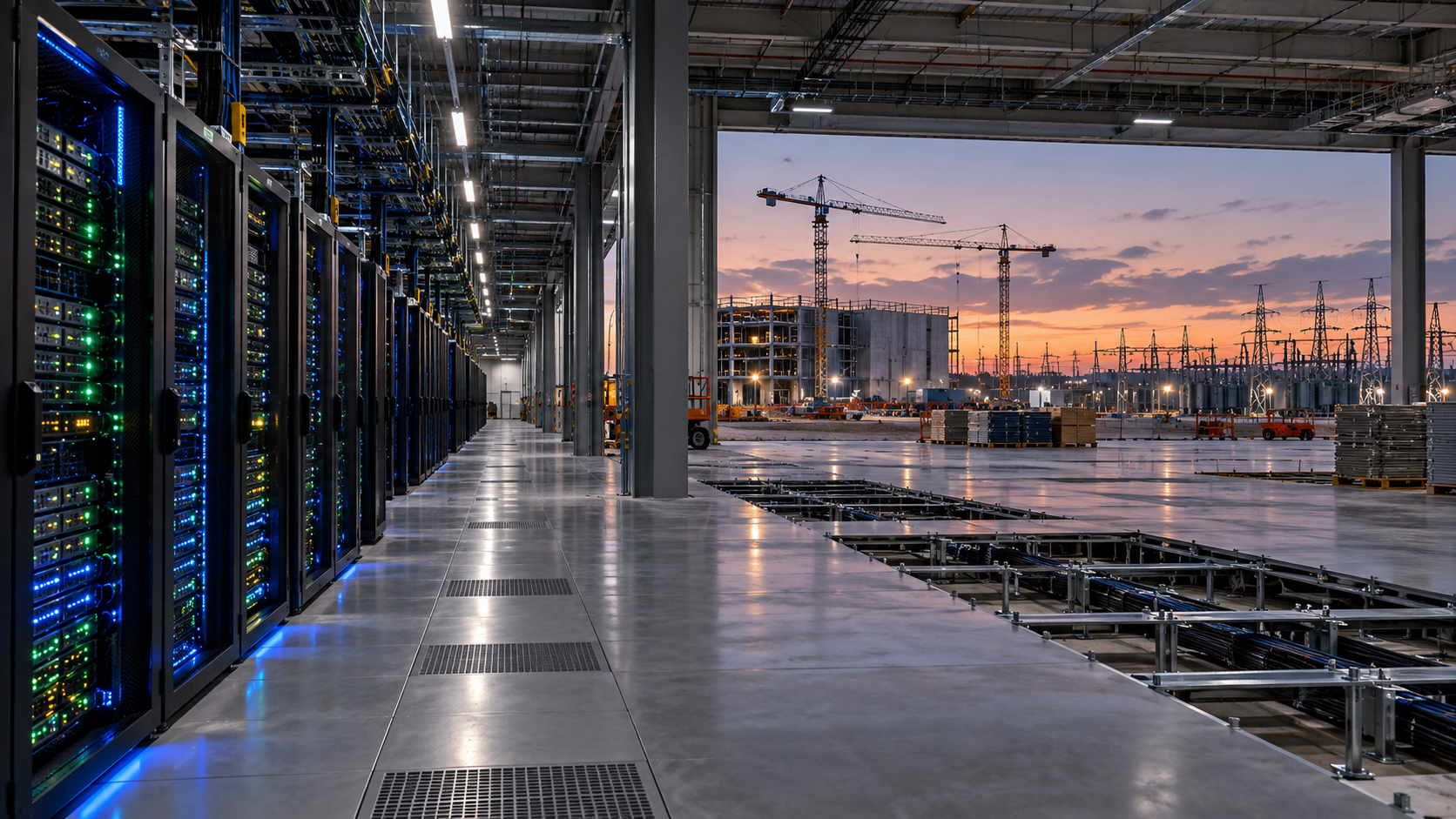
The AI industry has learned to describe ambition in physical units: accelerators ordered, campuses announced, power reserved, and capital committed. Those numbers are tangible, comparable, and easy to put in a presentation. They also obscure the commercial variable that will decide which infrastructure bets work: paid utilization.
A scarce cluster is valuable because users compete for access. A widely available cluster is valuable only when workloads keep it busy at a price above its full cost. The transition from scarcity to abundance does not make compute unimportant. It changes the discipline required to profit from it.
Our contention is that the next infrastructure divide will not be between companies that possess chips and companies that do not. It will be between operators that can shape steady, valuable demand and operators holding expensive capacity whose customers remain experimental, intermittent, or highly price-sensitive.
A reservation is not a workload
Building AI capacity requires decisions years before demand becomes legible. Power interconnections, cooling systems, land, networking, and financing move at infrastructure speed, while models and application architectures move at software speed. A facility designed around today’s assumptions may open into a market with more efficient models, different hardware mixes, or customers unwilling to pay premium inference prices.
The Stanford AI Index has documented a recurring pattern: frontier training remains expensive while the cost of using capable models falls rapidly. That combination creates a peculiar market. Suppliers face enormous fixed commitments just as customers gain more ways to reduce the compute required for each useful result.
Those reductions are not edge cases. Quantization, distillation, caching, batching, speculative decoding, smaller specialist models, and better routing all attack inference cost. Open-weight ecosystems indexed by Hugging Face also give buyers alternatives to sending every task to the largest hosted model. Each improvement can expand demand, but it can also shrink the revenue attached to an existing unit of work.
This is why announced capacity, contracted capacity, and economically productive capacity must not be treated as synonyms. A reservation may be defensive. A pilot may not survive procurement. A benchmark run may create spectacular utilization for one week and none the next.
The workload portfolio is the real asset
AI datacenters are often discussed as though they manufacture one interchangeable commodity. In practice, the demand profile is a portfolio. Training jobs are large and schedulable but episodic. Consumer inference is continuous but latency-sensitive. Enterprise agents can be bursty and require data isolation. Video generation may consume substantial compute while facing volatile unit economics. Scientific workloads can tolerate queues but need unusual interconnect or memory configurations.
The best operator is not necessarily the one with the largest fleet. It is the one able to combine these workloads so that expensive systems spend less time idle without destroying service quality. That requires scheduling software, model optimization, networking, customer contracts, and product design to operate as one economic system.
Infrastructure analysis from specialists such as SemiAnalysis is useful because it treats accelerators as components of a larger machine: power delivery, memory, networking, cooling, and software determine usable output. Business planning needs one further layer. The machine must produce something customers value enough to buy again.
A credible investment case should therefore answer operational questions. What percentage of capacity is attached to recurring production traffic? How concentrated is that traffic among a few model vendors? Can workloads move across hardware generations? Who benefits when optimization cuts the compute per request: the customer, the platform, or both? What happens to margins when reserved capacity meets a price war?
Efficiency can increase demand and still punish weak assets
The optimistic response is Jevons-style: cheaper inference will create more inference. That is likely true in aggregate. Software absorbed falling storage and bandwidth costs by inventing more uses for both. AI will do the same.
But aggregate growth does not rescue every investment. Demand can expand while shifting toward different chips, regions, latency tiers, or model sizes. A cheaper unit of intelligence may create a huge market and simultaneously strand facilities with the wrong power price or interconnect. “AI usage will grow” is a sector thesis, not an underwriting model.
This distinction also matters for software companies purchasing capacity. Owning or reserving compute can secure supply and improve margins at scale. It can also convert a flexible product experiment into a fixed-cost obligation. Before making that trade, a company should understand its demand curve by customer, task, latency requirement, and model class. Tokens alone are a weak planning unit because equal token counts can carry radically different value.
From compute strategy to demand engineering
The durable advantage will come from demand engineering: designing products and commercial agreements that transform irregular experimentation into predictable, valuable workloads. That may mean asynchronous features that fill off-peak capacity, routing systems that match tasks to cheaper models, or pricing based on completed work rather than raw consumption.
It also means resisting vanity utilization. A cluster can be busy generating outputs nobody wants. Useful utilization connects infrastructure activity to retained customers, completed business processes, or research results that justify continued spending.
The buildout is real, and much of it will be necessary. But steel, silicon, and megawatts are the opening position, not the business. The scarce capability is becoming the judgment to decide what should run, where it should run, and who will keep paying when compute is no longer scarce enough to sell itself.
Advertisement