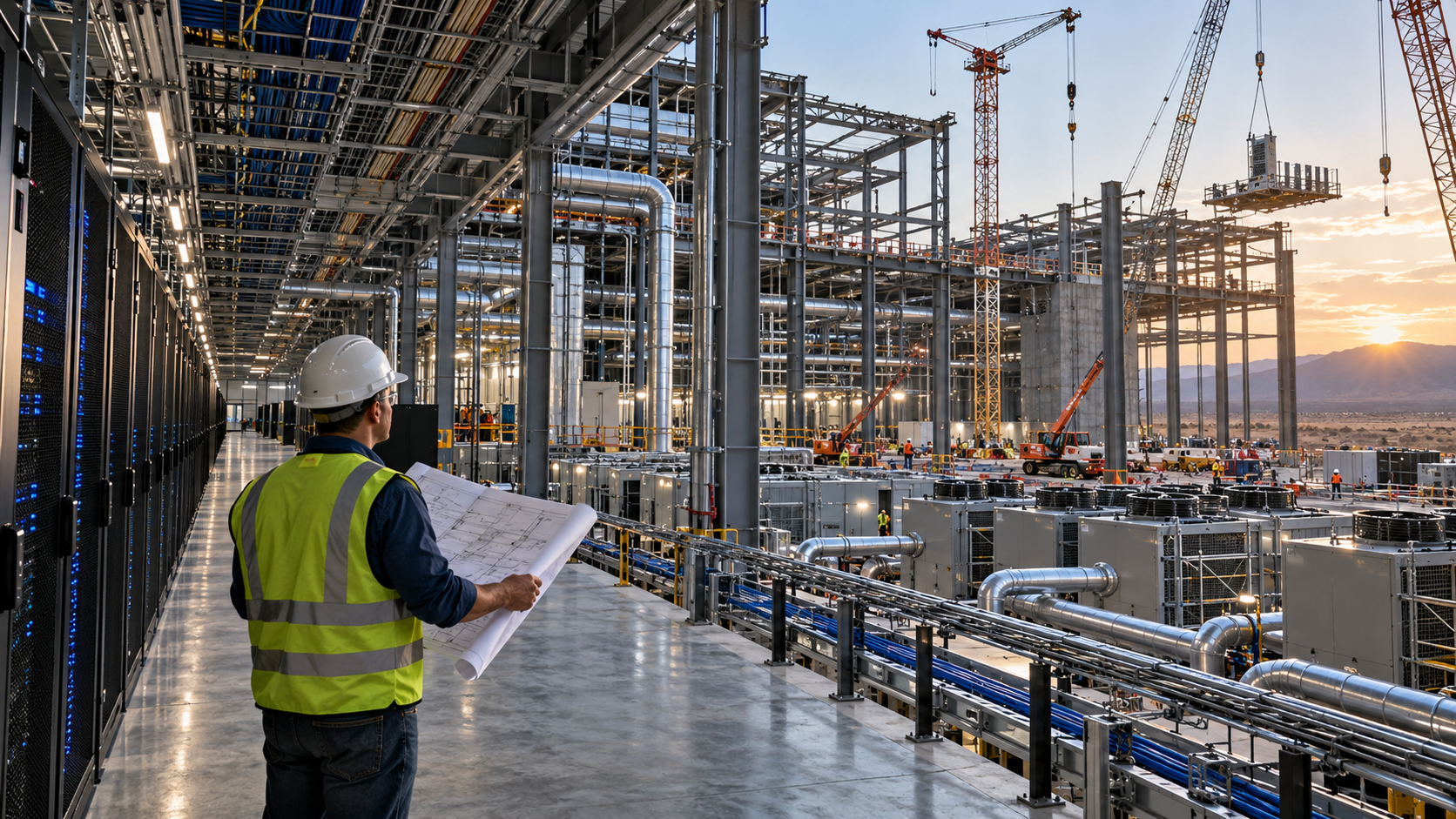
The conventional account of AI infrastructure is simple: demand is rising, accelerators are scarce, and the companies that build the most capacity will win. That story rewards scale, but it understates the risk attached to scale. A data center is a long-lived industrial asset being commissioned for a software market that can change character between planning approval and opening day.
The relevant scarcity is therefore not just compute. It is optionality: the ability to redirect capital, power, cooling, and hardware when assumptions change. A campus optimized for one accelerator generation, one thermal profile, or one giant training customer may look efficient on a spreadsheet. It can also become an expensive constraint if inference shifts toward smaller models, new chips require different cooling, or customers demand capacity in another jurisdiction.
The International Energy Agency’s Energy and AI report makes the timing mismatch unusually clear. Data centers can be delivered faster than much of the energy infrastructure supporting them, while grids, generation, and transmission require longer planning cycles and large upfront commitments. AI companies are discovering that software-speed ambition must pass through transformer queues, utility negotiations, water constraints, permitting, and construction labor.
Utilization is the number beneath the headlines
Announced capacity is not the same as economically productive capacity. The crucial variable is utilization over the asset’s life. An accelerator that is technically occupied but running poorly matched workloads can destroy value just as surely as an empty server hall. So can clusters stranded behind network bottlenecks, delayed electrical connections, or insufficient cooling.
This changes how infrastructure advantage should be evaluated. The strongest operator is not necessarily the company with the largest announced build. It is the company that can keep heterogeneous assets useful as workloads evolve. That demands excellent schedulers, portable software, workload forecasting, networking expertise, and commercial contracts that distribute risk. The glamorous asset is the chip; the durable advantage may be the control plane that prevents thousands of chips from becoming an inflexible fleet.
Specialist analysis from SemiAnalysis has helped make the physical systems behind AI visible: clusters are bounded by networking, memory, power delivery, cooling, and system-level efficiency rather than processor counts alone. The business implication is broader. Every infrastructure promise contains dependencies outside the model lab, and each dependency carries a different replacement cycle.
Design the balance sheet as carefully as the cluster
AI providers are responding with partnerships, leases, capacity reservations, and special-purpose financing. These arrangements can accelerate deployment, but they may also hide rigidity. A long reservation secures supply while transferring demand risk to the buyer. A lease reduces immediate capital expenditure while preserving a payment obligation. A strategic partnership may diversify funding but introduce exclusivity or governance constraints. None of these structures is inherently good or bad; their quality depends on what happens when the forecast is wrong.
Boards should ask infrastructure teams questions borrowed from real-options analysis. How cheaply can this site accommodate the next cooling design? Can the power allocation support a mixed fleet? Can capacity be sold to another workload class? Which commitments can be delayed until demand is observable? What is the cost of exiting a contract, not merely entering it? A plan that is slightly more expensive at peak utilization may be far more valuable across several plausible futures.
There is also a geographic dimension. The best location for cheap electricity may be poor for latency, talent, data sovereignty, or network connectivity. The best region for enterprise customers may have a constrained grid. Treating location as a single-variable energy decision ignores the fact that inference is becoming part of operational workflows. Some workloads can tolerate distance; others cannot. The portfolio should reflect that difference.
Efficiency improvements do not eliminate this strategic problem. If models become cheaper to run, lower prices can stimulate more usage. If smaller models handle routine work, premium systems may absorb more complex and compute-intensive tasks. Forecasts should not pretend to know the exact balance. They should expose which investments remain sensible across several demand curves.
For software companies buying AI services, this analysis matters too. Vendor selection increasingly includes an implicit infrastructure bet. A low price may be subsidized by aggressive capacity commitments. A guarantee may depend on a provider’s access to constrained power or hardware. Procurement teams should examine model quality, but also portability, rate limits, regional availability, and the cost of moving workloads if economics change.
The infrastructure race will produce winners, but sheer construction volume is an incomplete predictor. The companies best positioned for the next phase will combine scale with reversibility. They will build sites that can accept new hardware, contracts that can absorb uncertain demand, and software that can move work across a mixed fleet. Compute matters. The capacity to change one’s mind may matter more.
Advertisement