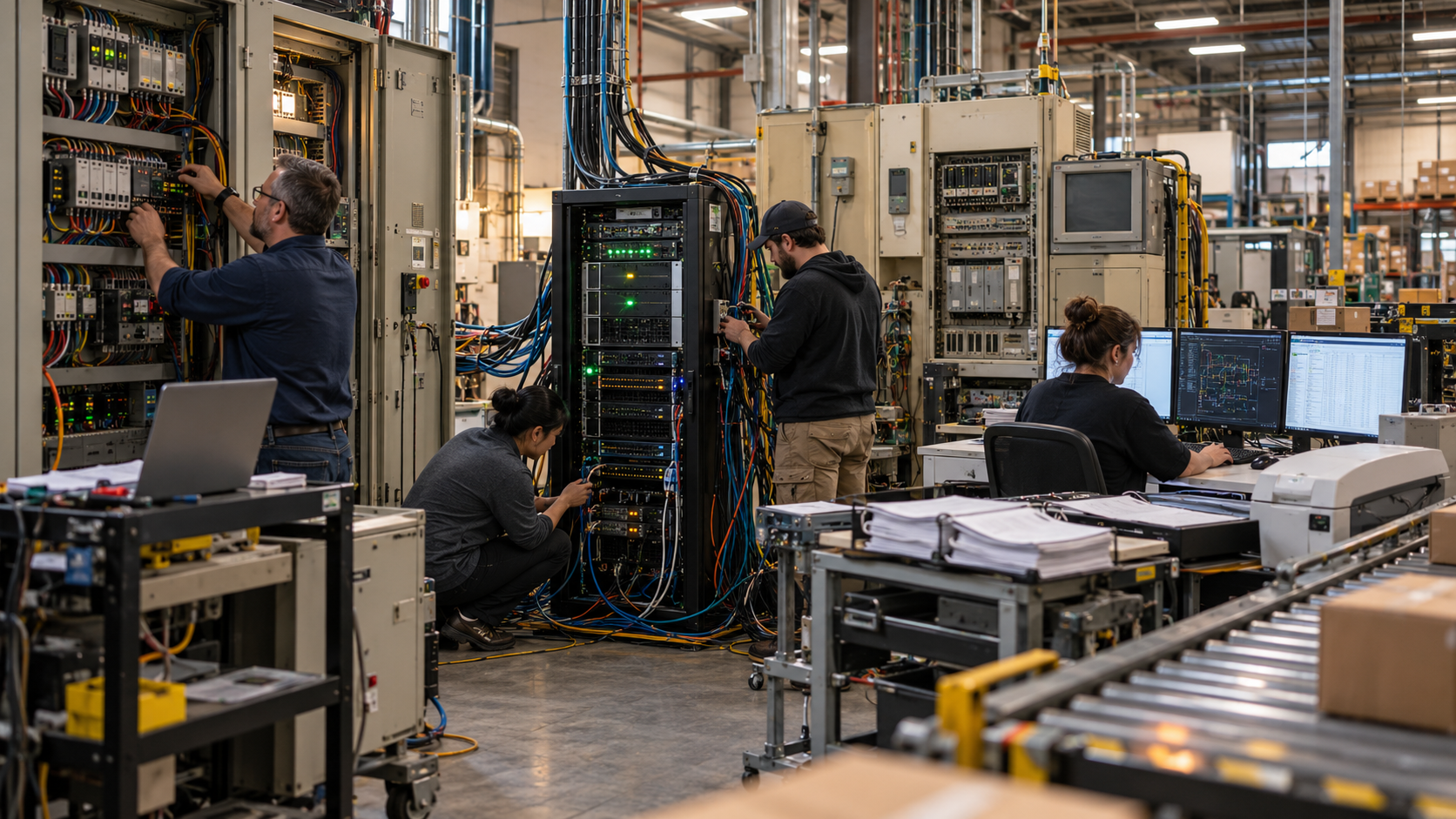
The price of model intelligence keeps falling, yet enterprise AI projects do not become proportionally cheaper. This apparent contradiction disappears once we stop treating the model as the product. For most organizations, the model is a component delivered to the edge of the business. The costly work begins in the last twenty feet: connecting it to real data, real authority, real exceptions, and a person who will answer when something goes wrong.
Software history offers a useful analogy. Cheap bandwidth did not eliminate the difficulty of building reliable networks. Inexpensive cloud compute did not make architecture irrelevant. Likewise, cheaper inference does not dissolve the accumulated complexity of a company’s processes. It simply exposes that complexity faster.
The 2026 Stanford AI Index economy chapter describes broad organizational adoption alongside much earlier-stage use of agents. That gap matters. Trying a model in one business function is comparatively easy. Allowing a system to update an invoice, negotiate a return, modify production data, or communicate a binding decision is an integration and governance problem.
Every workflow contains a shadow specification
A process diagram might say that a claims analyst reviews documents and approves eligible requests. The working process is usually more elaborate. One customer receives special handling because of a contract amendment. A missing field can be inferred from another database, except in two jurisdictions. An experienced employee knows which upstream system occasionally duplicates records. None of this may appear in the official documentation.
These informal rules form a shadow specification. Conventional software projects discover it during requirements work. AI projects often discover it after deployment, because a fluent model creates the impression that it understands the process before it has encountered its boundaries. The prototype performs beautifully on curated examples, then meets an exception that the organization itself has never written down.
This is why “connect the model to our data” is a misleadingly small sentence. The work includes identity resolution, permissions, data freshness, schema translation, retention policy, audit trails, and decisions about which system is authoritative. The model call may be the shortest function in the codebase.
Token margins are not a moat
Many AI products still price as if access to a capable model were scarce. They wrap an API, add a narrow interface, and charge a substantial premium over inference cost. That can fund an early product, but it is not a durable position. Models improve, providers compete, and customers learn to reproduce shallow workflows.
The defensible layer is operational depth: integrations that respect a company’s permission model, evaluations built from its failure history, and interfaces designed around its escalation paths. Specialist publications such as Interconnects track the model and infrastructure landscape closely, but the commercial implication is often missed. As foundation capabilities diffuse, value migrates outward into implementation, distribution, proprietary workflow context, and trust.
This changes how AI projects should be budgeted. Teams commonly scrutinize token spend while treating integration labor as a one-time setup cost. The ratio is usually backwards. Inference is a visible meter; organizational complexity is a recurring obligation. Every changed policy, renamed field, acquired subsidiary, or revised approval threshold can invalidate part of the deployed system.
An honest business case therefore includes the cost of maintaining the connection between probabilistic behavior and institutional rules. It funds regression tests, data contracts, workflow owners, incident response, and periodic review of human overrides. Without those line items, the projected return is built on unpaid maintenance.
The winning unit is a changed operation
AI vendors like to sell seats, messages, copilots, or agents. Customers ultimately buy a changed operation. Did the order move faster without increasing incorrect shipments? Did engineers resolve incidents sooner without creating hidden security exposure? Did support improve without pushing customers into an automated maze?
That suggests a better product strategy. Start from an operational metric and work backward. Choose one constrained decision point. Instrument the existing baseline. Build the smallest model-assisted workflow that can affect it. Record exceptions rather than smoothing them away. Only then widen the system’s authority.
The practitioner conversations collected by communities such as Latent Space repeatedly show that successful AI systems are combinations of models, tools, retrieval, evaluation, and product judgment. Enterprises should take that composition seriously. Model selection matters, but it is one design decision among many—and increasingly a reversible one.
At XioX, our view is that the next enterprise AI divide will not be between companies with and without access to frontier models. Nearly everyone will have access. The divide will be between organizations that can translate their messy operating reality into testable, maintainable systems and those that keep purchasing impressive demonstrations.
The last twenty feet are expensive because they contain the business itself: its exceptions, incentives, permissions, and promises. That is not friction surrounding the AI opportunity. It is where the opportunity becomes real.
Advertisement