The public story of AI infrastructure has been dominated by training: enormous clusters, headline capital expenditures, and models whose construction can be described as a singular industrial event. That framing is becoming incomplete. As AI products mature, the harder economic problem moves downstream to inference—the continuous business of turning deployed capacity into useful answers at the moment users request them.
Training resembles a planned construction project. Inference resembles operating a utility whose customers dislike queues, whose demand is difficult to forecast, and whose machinery depreciates quickly. The second problem is less cinematic, but it will decide which AI products have durable margins.
A token has more than one price
Teams often discuss inference through a single number: cost per token. That average conceals the trade-off that matters operationally. Hardware can process requests efficiently when work is batched, but users experience the serial path—the delay before an answer starts and the speed at which it continues. Improving one dimension can worsen the other.
The paper Inference Economics of Language Models formalizes this tension as a frontier between token cost and serial generation speed under compute, memory, network, and latency constraints. The business implication is straightforward: there is no universally cheapest deployment. There are different efficient points for different promises made to users.
A background document-processing job can wait for a large batch. An interactive coding agent cannot pause unpredictably after every tool result. A voice interface has tighter latency constraints still. Selling all three from one undifferentiated pool encourages either poor utilization or poor experience.
The costly asset is readiness
Consider a service designed for a sharp morning peak. Enough accelerators must be available to absorb that peak without sending latency through the roof. For the rest of the day, some of that capacity may be underused. The waste is not evidence of careless engineering; it is the inventory required to uphold a response-time promise.
This is familiar in airlines, electricity markets, and cloud computing. AI adds unusual complications. Requests vary dramatically in context length and output length. Agentic workloads generate bursts separated by tool calls. Model routing can change the hardware required for the next step. Memory devoted to cached context may become as consequential as arithmetic throughput.
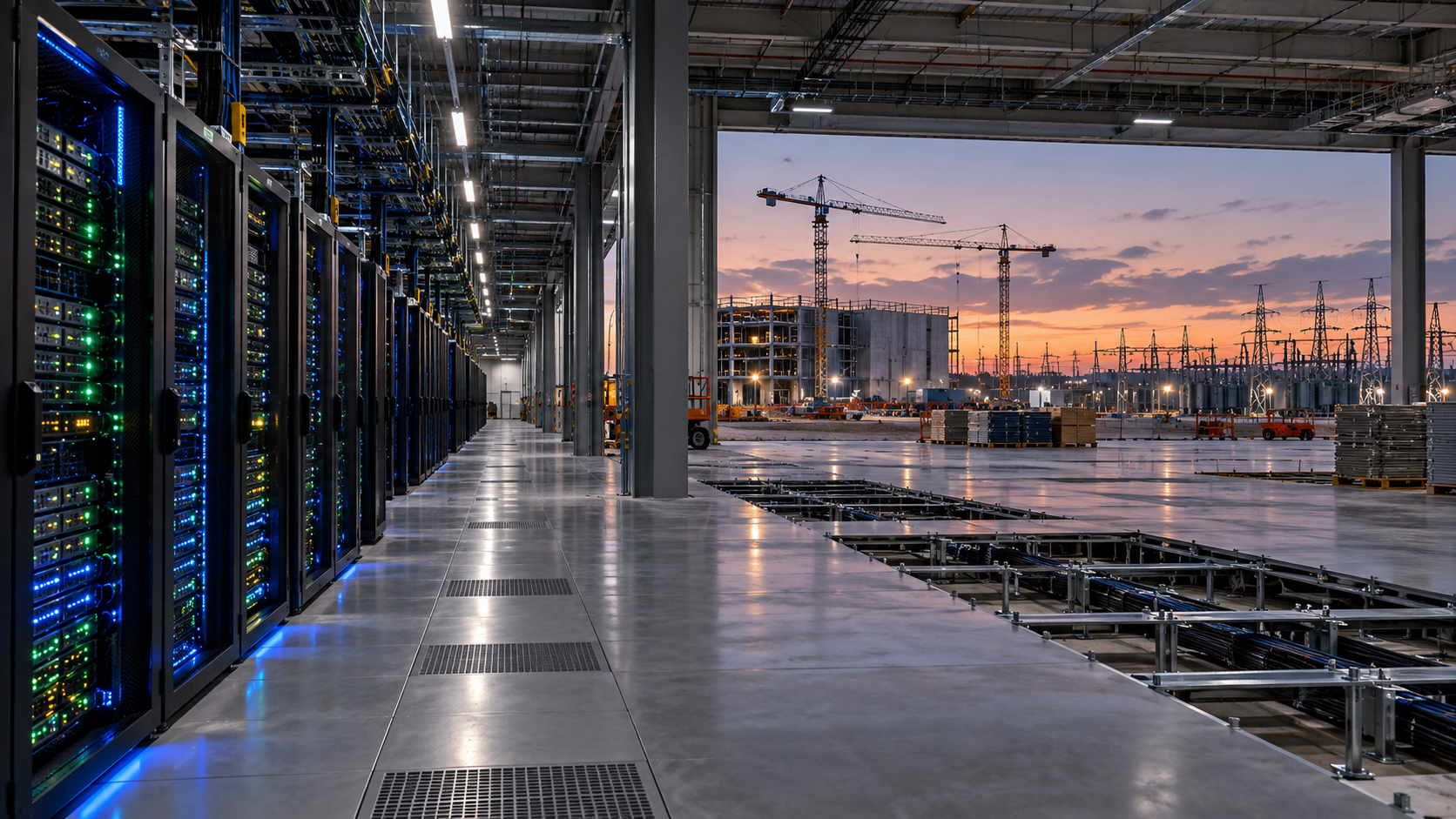
Datacenter constraints also reach beyond chips. Power delivery, cooling, land, and grid interconnection determine how quickly capacity can appear. Google’s overview of its data center infrastructure is a useful reminder that compute exists inside physical systems with long planning cycles. A software team can change its model-routing policy this week; a region cannot produce a new substation on the same schedule.
Product design is infrastructure design
The most effective cost optimization may happen before an inference request reaches a GPU. Products can make expensive behavior visible, move deferrable work into explicit background jobs, reuse stable context, and ask users whether they prefer speed or depth. Those are interface decisions, but they shape the demand curve.
Conversely, a product that promises instant, unlimited, maximum-quality reasoning creates an infrastructure obligation whether or not the pricing page acknowledges it. If every interaction defaults to the largest model and the longest context, optimization teams are left negotiating with a promise already embedded in the interface.
This is why model selection should become a runtime discipline rather than a procurement decision. Small models, retrieval systems, deterministic code, and cached results can handle portions of a workflow. Larger models can be reserved for steps where their additional capability changes the outcome. The point is not to route everything to the cheapest component. It is to spend expensive inference where the user can perceive its value.
Margins will reveal architectural honesty
During a rapid adoption phase, companies can tolerate blurry unit economics. Growth hides idle capacity; bundled subscriptions hide extreme users; falling hardware costs are assumed to rescue inefficient designs later. Some of those bets will work. Others will discover that cheaper tokens stimulate more elaborate workloads faster than they reduce the bill.
Agents sharpen this effect. A conventional assistant might answer once. An agent can plan, search, call tools, inspect results, revise its approach, and invoke additional models as evaluators. The user sees one completed task while the provider serves an internal conversation. Revenue is attached to the outcome; cost accumulates along the trajectory.
That makes observability a financial capability. Operators need to understand cost per successful task, not merely cost per request. They need failure-adjusted measures that include retries, abandoned runs, cache misses, and human intervention. A workflow that looks efficient per token may be expensive per resolved case if it frequently travels down unproductive branches.
At XioX, we expect the strongest AI companies to treat inference capacity as perishable inventory. They will segment workloads by urgency, design products that expose meaningful trade-offs, and connect model behavior to contribution margin at the task level. The decisive infrastructure advantage will not simply be owning more accelerators. It will be knowing precisely when a customer’s problem deserves one—and keeping the rest from waiting expensively in the dark.
Advertisement