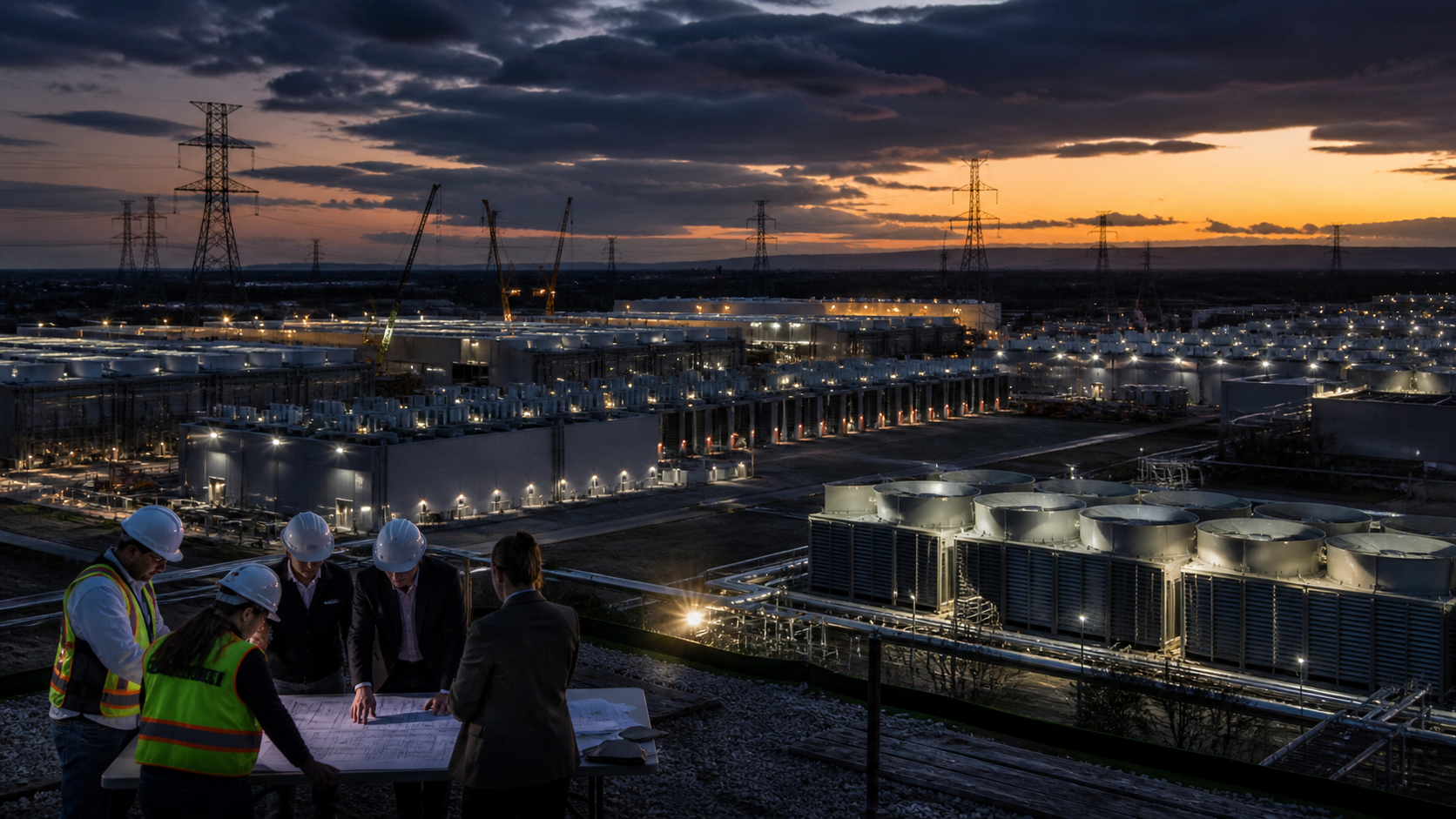
The most misleading habit in AI business analysis is describing the sector as if it were just another software wave. Software still matters, obviously. Interfaces matter, distribution matters, product taste matters. But those are no longer the only economics that count. The center of gravity has moved downward, into power contracts, network topology, cooling systems, chip supply, and the patience to deploy capital on a timetable that looks less like SaaS and more like energy infrastructure.
You can see the shift in the kind of public material the industry now produces. The cadence of launches on OpenAI's newsroom still reads like product news, but the subtext is infrastructure stress: more users, more modalities, more enterprise usage, more always-on demand. The same pattern shows up across Anthropic's newsroom and other frontier labs. Every product breakthrough quietly drags a physical supply chain behind it. The software layer gets the headlines. The utility layer gets the invoices.
This matters because investors, founders, and policymakers are still using the wrong mental model. They ask which app will dominate or which model will win mindshare. Those are fair questions, but they are no longer sufficient. If AI capabilities keep expanding, the more durable strategic advantage may belong to the organizations that can secure power, finance compute, and operate reliable datacenter capacity under political and environmental constraint. In other words: the battleground is not just intelligence. It is industrial coordination.
Why the Stack Is Tilting Toward Heavy Industry
The software industry trained a generation of founders to believe that capital efficiency was a virtue bordering on morality. A small team could build a large business with modest fixed costs and plenty of gross margin. AI does not fully obey that script. The frontier model layer is expensive to train, expensive to serve, and increasingly expensive to defend. Even firms that do not train their own models feel the pressure through inference costs, usage volatility, and the expectation that AI features will be fast enough to feel ambient.
The broader evidence base now reflects that reality. The AI Index 2026 is useful not because it hands executives a single answer, but because it makes the scale question impossible to ignore. AI is not merely diffusing through applications; it is reconfiguring the cost structure beneath them. That means the winners will not necessarily be the firms with the prettiest demos. They may be the firms with the strongest financing relationships, the best infrastructure partnerships, and the operational discipline to turn giant fixed costs into dependable service.
This is also why the AI conversation increasingly overlaps with national strategy. A datacenter is not just a warehouse full of servers. It is a claim on land, electricity, water, transmission planning, and regulatory goodwill. A model release can be global in minutes; the infrastructure supporting it cannot. It is stubbornly local. Communities ask what they get in return. Utilities ask how to balance large, spiky loads. Governments ask whether the capacity being built creates domestic resilience or dependency. Once those questions arrive, AI stops looking like a pure software category and starts looking like a public-interest infrastructure category with private incentives attached.
That creates a new filter for business quality. We should be skeptical of AI strategy that assumes compute will remain a commodity and that product differentiation alone will rescue weak economics. The more plausible future is one where costs remain highly asymmetric. Some companies will have privileged access to capital, chips, energy, and distribution. Others will build excellent experiences on top of rented intelligence but remain exposed to platform pricing and service-level shifts they do not control. That is not a moral judgment; it is simply what happens when an industry depends on scarce physical inputs.
For application companies, this does not mean the game is over. It means the bar is higher. If you are building on someone else's model and infrastructure, you need more than a clever wrapper and a generic automation pitch. You need domain lock-in, proprietary workflow position, or a service model that captures value even if the base models converge. The comfortable fantasy that every AI startup can scale like lightweight software is already colliding with the reality that much of the value will pool around infrastructure owners and the companies that shape demand at scale.
There is a political implication too. When AI resembles utilities, society stops treating it like a toy market. Expect more scrutiny on energy consumption, grid planning, environmental tradeoffs, and concentration risk. Some executives will complain that this slows innovation. A better reading is that AI has become consequential enough to attract the kind of oversight reserved for industries that genuinely shape economic capacity.
At XioX, we think this is the adult phase of AI business. The field is moving past the era when the main question was which lab could impress the internet this week. The harder question now is who can sustain intelligence as a service at industrial scale without breaking the economics, the infrastructure, or the trust of the institutions around them. That is not just a software challenge. It is the operating logic of a utility.
Advertisement