The price of machine intelligence appears to be collapsing. At the same time, the physical infrastructure built to produce it is becoming one of the largest capital-allocation stories in technology. Those statements are not contradictory. They describe two different layers of the same market—and confusing them leads to bad strategy.
At the retail layer, model inference is becoming cheaper and more abundant. The Stanford AI Index documented a dramatic fall in the cost of achieving a fixed level of benchmark performance. Competition, smaller models, quantization, better serving software, and improved chips all push in the same direction. For application builders, a capability that was uneconomic two years ago may now be routine.
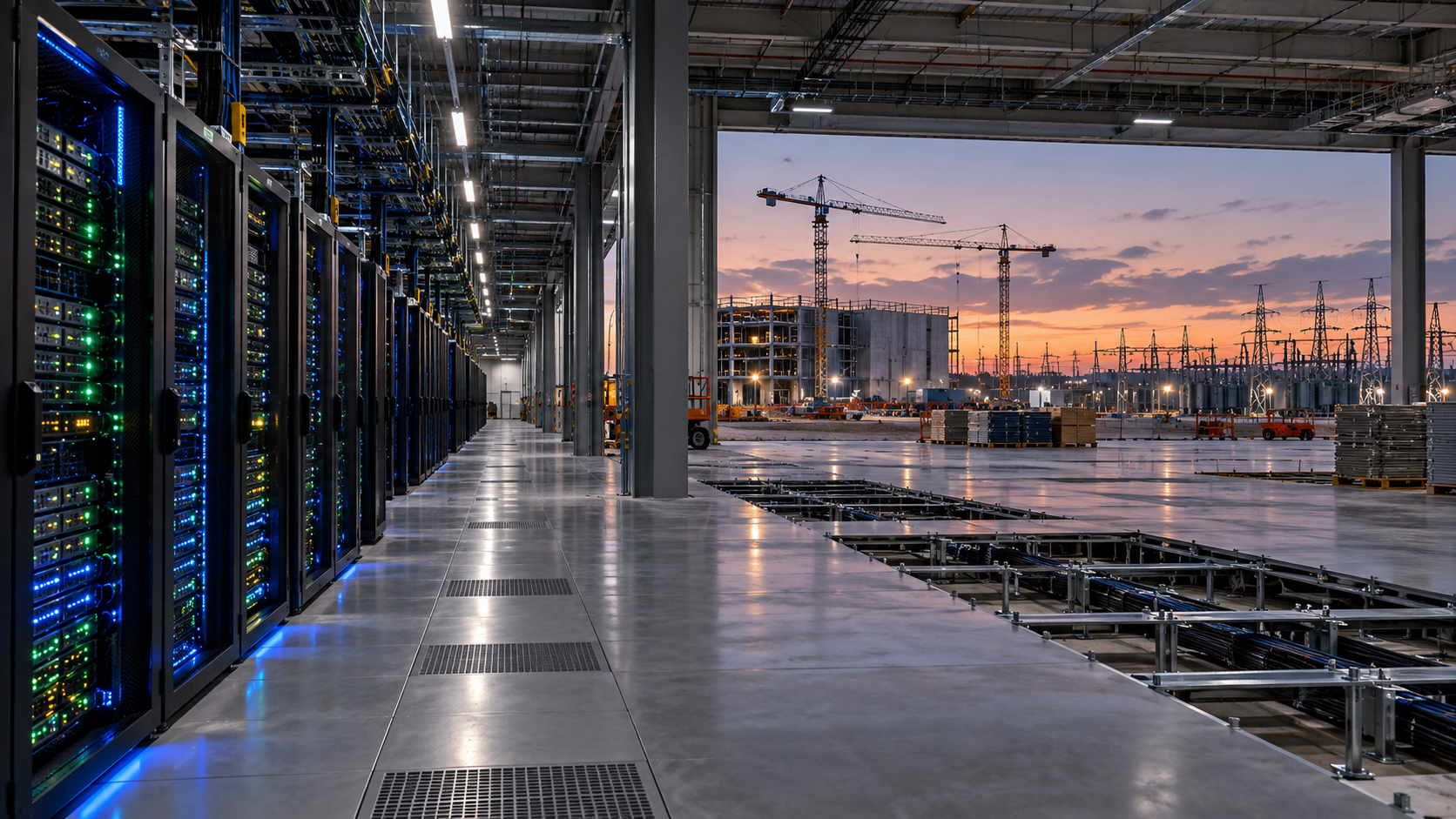
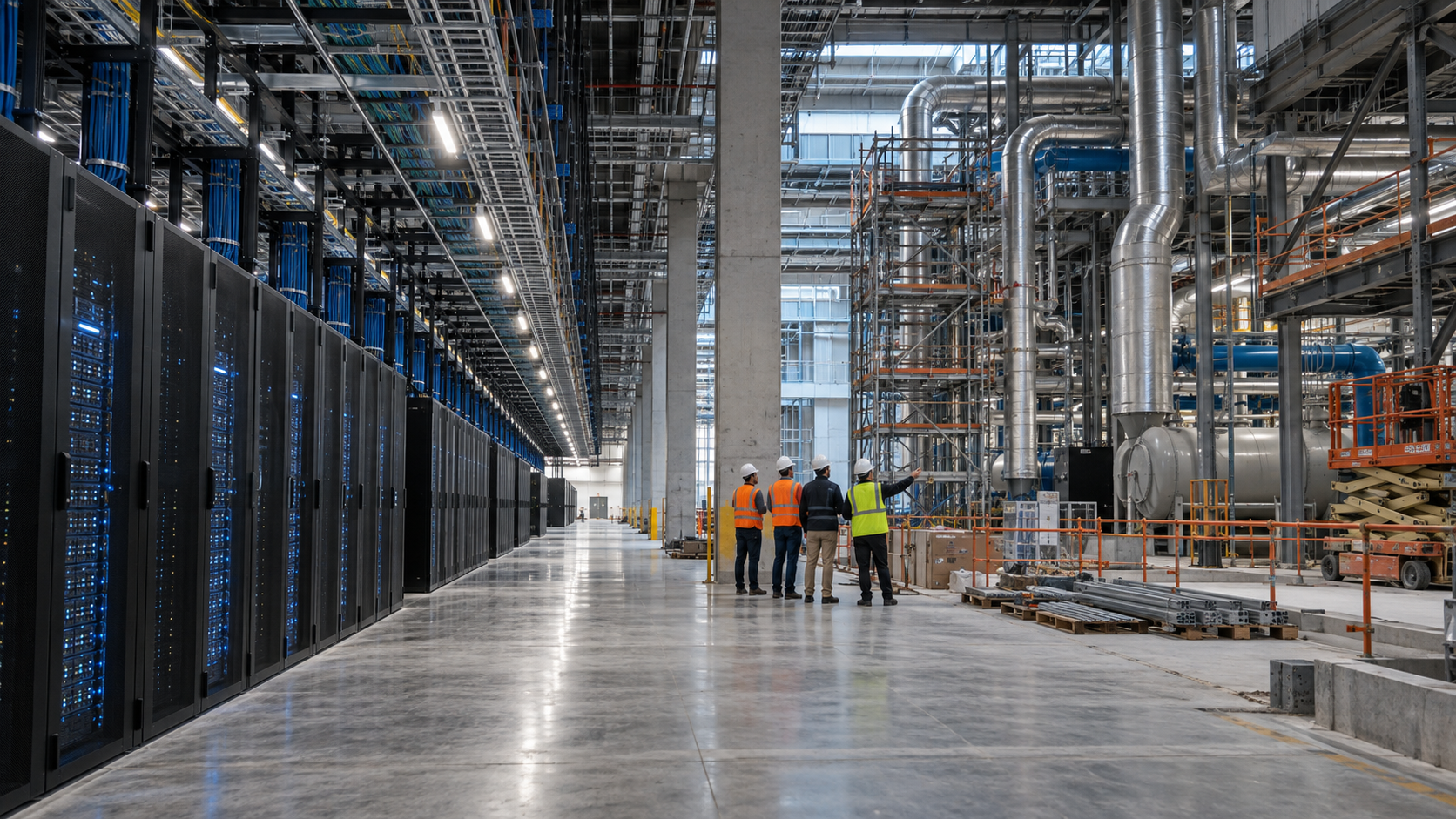
Underneath that abundance sits an industrial system with long lead times: power generation, grid interconnection, substations, cooling equipment, land, networking, chip packaging, and data-center construction. Tokens may be priced like a digital commodity, but their factories are neither weightless nor instantly replaceable.
The value is migrating away from raw access
When a resource becomes cheaper, businesses often assume that value disappears from the category. Usually it moves. Falling compute prices erode the defensibility of products whose only advantage is privileged access to a capable model. They improve the economics of products that combine models with distribution, proprietary workflow context, trustworthy execution, or domain-specific feedback.
This is why the most useful question for an AI company is not, “Will inference get cheaper?” It almost certainly will at comparable capability levels. The better question is, “Which parts of our product become more valuable when competent inference is plentiful?”
A customer-support product with no integration depth becomes easier to copy. A support system connected to permissions, order history, policies, quality review, and escalation paths becomes more useful as model costs decline because more interactions can be processed, checked, and improved. Cheap intelligence rewards products that have somewhere productive to put it.
The same logic applies to infrastructure providers. A data center is not valuable merely because it contains accelerators. Its value depends on utilization, energy economics, networking, reliability, financing terms, and the useful demand it can serve over the asset’s life. Analysis from specialists such as SemiAnalysis is valuable precisely because the AI stack cannot be understood by counting chips alone.
Utilization is the number hiding behind the headlines
Capital expenditure is easy to announce and difficult to interpret. A large commitment can signal demand, defensive positioning, supply-chain bargaining, or fear of being capacity-constrained. It does not automatically demonstrate attractive unit economics.
Utilization connects the physical and digital layers. Expensive hardware sitting idle is a financing problem. Fully utilized hardware serving low-margin workloads can be a pricing problem. Hardware reserved for intermittent peaks can be an architecture problem. The operator must balance all three while the performance of new chips and models changes the amount of compute required for a given result.
This volatility creates an unusual investment profile. The buildings, power contracts, and cooling systems may last for decades; the commercially preferred accelerator may change much sooner. Infrastructure planners are therefore making long-lived commitments around a rapidly moving computational core.
For buyers of AI services, that should encourage skepticism toward two opposite sales pitches. One says scarcity will last forever, so customers must lock themselves into today’s platform. The other says compute will become essentially free, so architecture and cost controls do not matter. Both extrapolate one layer of the market across the entire stack.
Design for falling prices and persistent constraints
Software teams should assume that model prices will continue to move and that constraints will keep reappearing in new forms. Today’s constraint may be accelerator supply; tomorrow’s may be power, latency, data residency, memory bandwidth, or the cost of verifying agentic work.
That calls for deliberately portable systems. Separate business logic from model-specific prompting. Measure cost per successful workflow, not cost per token. Route simple tasks to smaller models. Cache stable results. Preserve the ability to change providers without rebuilding the product’s control plane. Most importantly, include review, retries, and failure handling in the economic model.
The market often celebrates lower input prices without asking whether systems consume more of the input. When inference becomes cheaper, developers tend to add longer contexts, multiple candidates, evaluator calls, and autonomous loops. The cost per token falls while the number of tokens per completed job rises. This is not necessarily wasteful; additional computation can purchase reliability. But it means headline API prices are a poor proxy for application margins.
Epoch AI’s work on compute trends and AI economics offers a useful reminder that technical efficiency, expenditure, and total consumption can all increase together. Efficiency expands the set of viable uses, which expands demand.
The durable business opportunity is not to bet exclusively on scarcity or abundance. It is to build products that benefit from cheaper intelligence while remaining disciplined about the costly systems beneath it. Tokens can look disposable on an invoice. The grid connection, data center, and organizational commitments behind them are anything but.
Advertisement