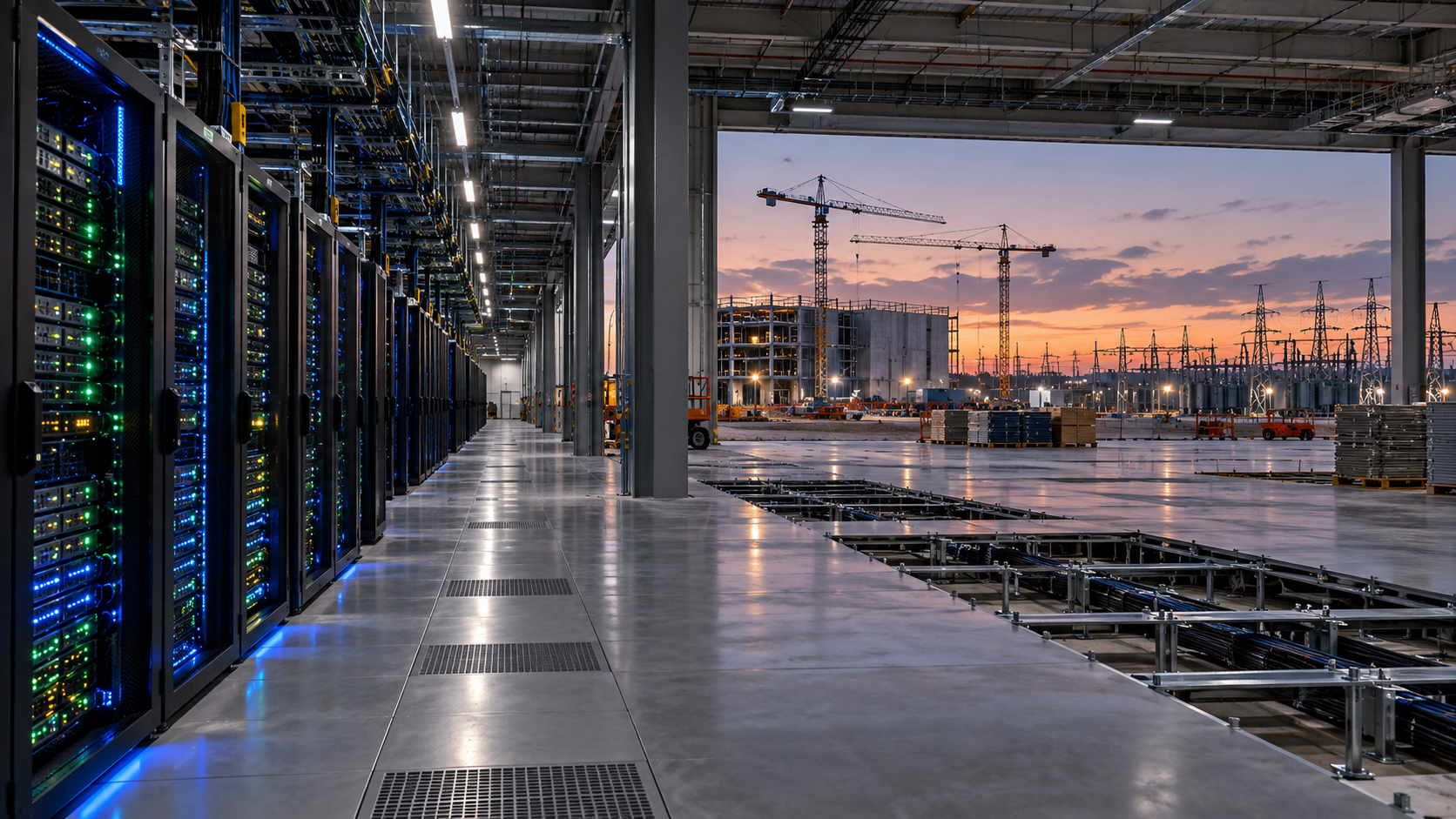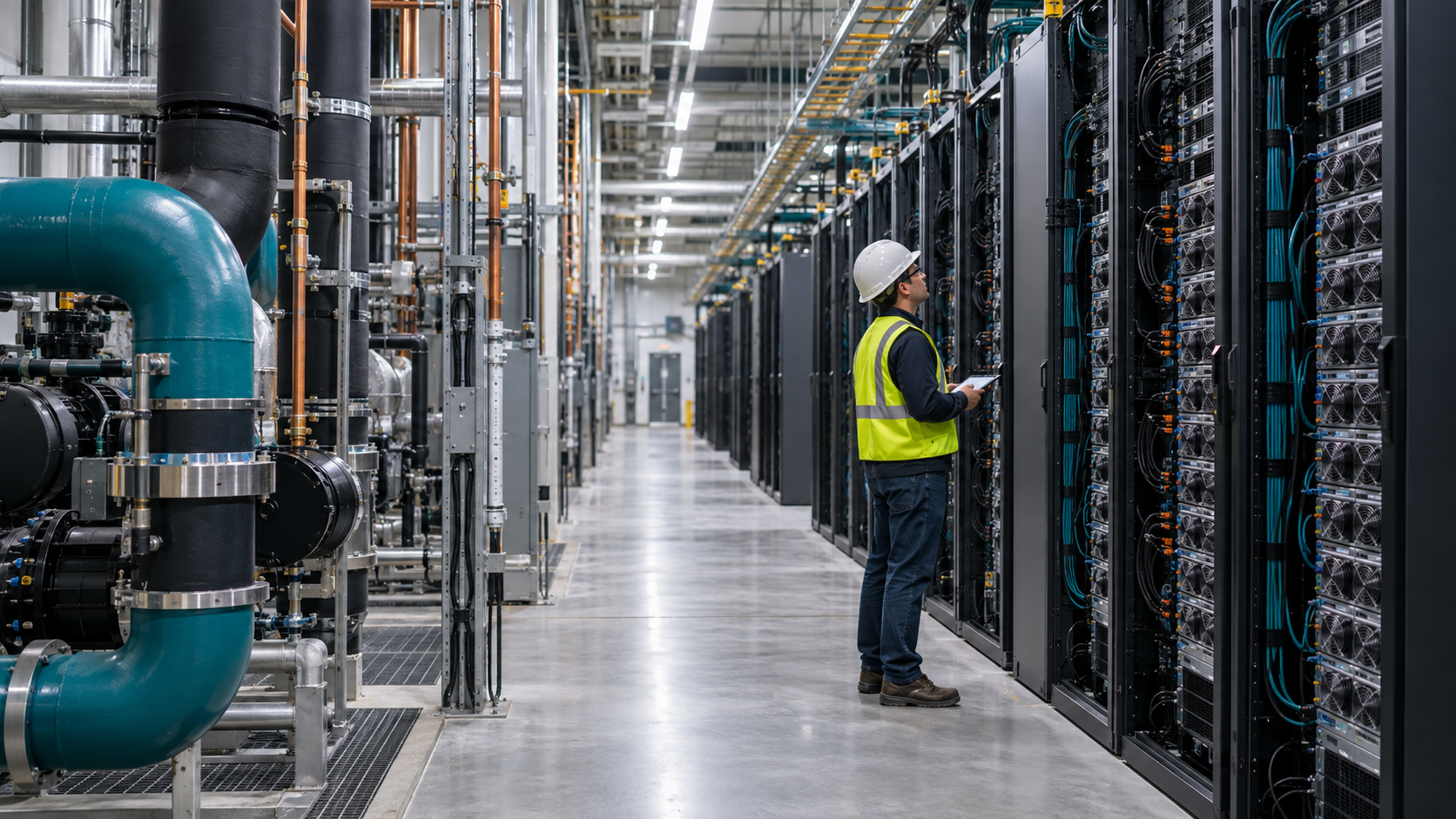
The first phase of the generative-AI buildout rewarded acquisition. If a company could secure accelerators, data-center capacity, and enough power, it could train larger models or serve demand competitors had to turn away. That scramble made hardware inventory look like the moat. But inventory is an early-market advantage. In a maturing market, the decisive question changes from “How many chips do you possess?” to “How much valuable work does the whole system produce per dollar and per megawatt?”
A GPU is not an isolated factory. It waits on memory, networking, storage, scheduling, cooling, software kernels, and incoming demand. Capacity reserved for a peak sits idle outside the peak; capacity packed too aggressively creates latency and reliability problems. Meta’s descriptions of its training and inference accelerator emphasize co-design across silicon, systems, and software. That is the important signal. The economic unit is not the chip. It is the serving stack.
Training bought machines; inference must operate them
Training is expensive, but it resembles a capital project: assemble a cluster, run a large job, produce an asset. Inference behaves more like a utility. Demand varies by hour, geography, customer, context length, model, and latency promise. Requests arrive in awkward shapes. Some can be batched; others cannot wait. Some need a large reasoning model; many can be handled by a smaller one. Every product feature becomes a continuing claim on electricity and capacity.
This shift changes the competitive vocabulary. Tokens per second matter, but so do accepted outcomes per joule, useful tool calls per dollar, cache hit rates, queue time, and the percentage of requests routed to the smallest sufficient model. Hardware utilization without application value is merely efficient waste. Conversely, a slower-looking configuration may win economically if it produces fewer retries, shorter outputs, or more tasks completed without human repair.
Custom silicon is one response because sufficiently stable, high-volume workloads justify specialization. Meta’s account of its first-generation MTIA discusses total cost of ownership and the balance among compute, memory bandwidth, and interconnect bandwidth. The broader lesson applies beyond hyperscalers: optimization migrates toward the bottleneck. Buying more arithmetic does little when memory movement, network contention, or poor batching dominates the workload.
The software organization becomes part of the power plant
Infrastructure efficiency is often presented as a facilities or compiler problem. Product architecture can overwhelm gains made in both. An application that sends an entire account history with every request, invokes a frontier model for routine classification, and retries blindly after malformed output burns capacity by design. No cooling innovation can compensate for a product team that treats tokens as free.
The strongest operators will connect application telemetry to infrastructure decisions. They will know which customer actions create long contexts, which prompts defeat caching, which agent loops expand without improving outcomes, and which latency promises force costly overprovisioning. They will make model routing and workload shaping product features rather than hidden platform chores. The useful comparison is to airlines: purchasing aircraft matters, but scheduling, load factors, turnaround times, and route economics determine whether the fleet earns its keep.
This is also why headline capital expenditure can mislead. Two companies can install similar clusters and obtain radically different businesses from them. One may have steady internal workloads, mature compilers, proprietary demand signals, and engineers who can tune the entire stack. Another may own impressive capacity but depend on volatile third-party demand and generic serving software. Their balance sheets show similar machinery; their productive systems are not similar.
Utilization is not the same as saturation
There is a dangerous version of this argument: keep every accelerator busy at all times. Saturation can increase tail latency, reduce maintenance windows, and leave no room for unexpected demand. A well-run system preserves deliberate slack. The aim is not maximum occupancy but maximum economically useful output under reliability constraints. That requires valuing resilience, including the ability to shed low-priority work or move requests between models when capacity tightens.
At XioX, we expect the infrastructure winners to expose these tradeoffs to software teams. Cost dashboards should connect a feature to its marginal inference burden. Evaluation pipelines should compare models using production request distributions, not tidy benchmark prompts. Capacity plans should distinguish optional deliberation from latency-critical service. These practices sound operational because the market is becoming operational.
Accelerator access will remain strategically important, and power availability may constrain expansion for years. Yet scarcity alone does not create a durable advantage. As the installed base grows, value moves into orchestration: matching models to requests, requests to hardware, and hardware to physical infrastructure. The moat will belong to organizations that turn electricity into trusted outcomes with the least friction—not those that can photograph the longest row of racks.
Advertisement