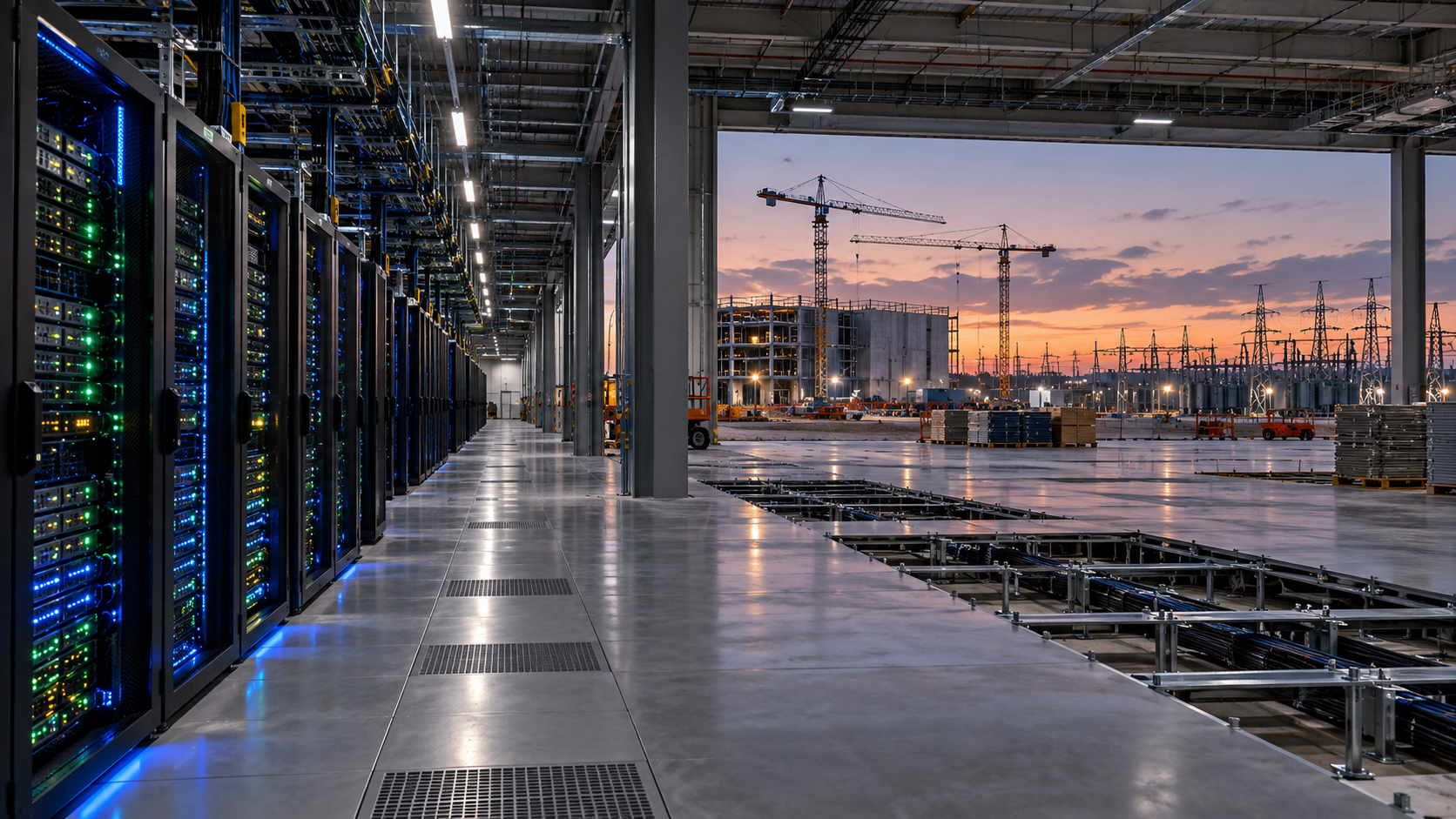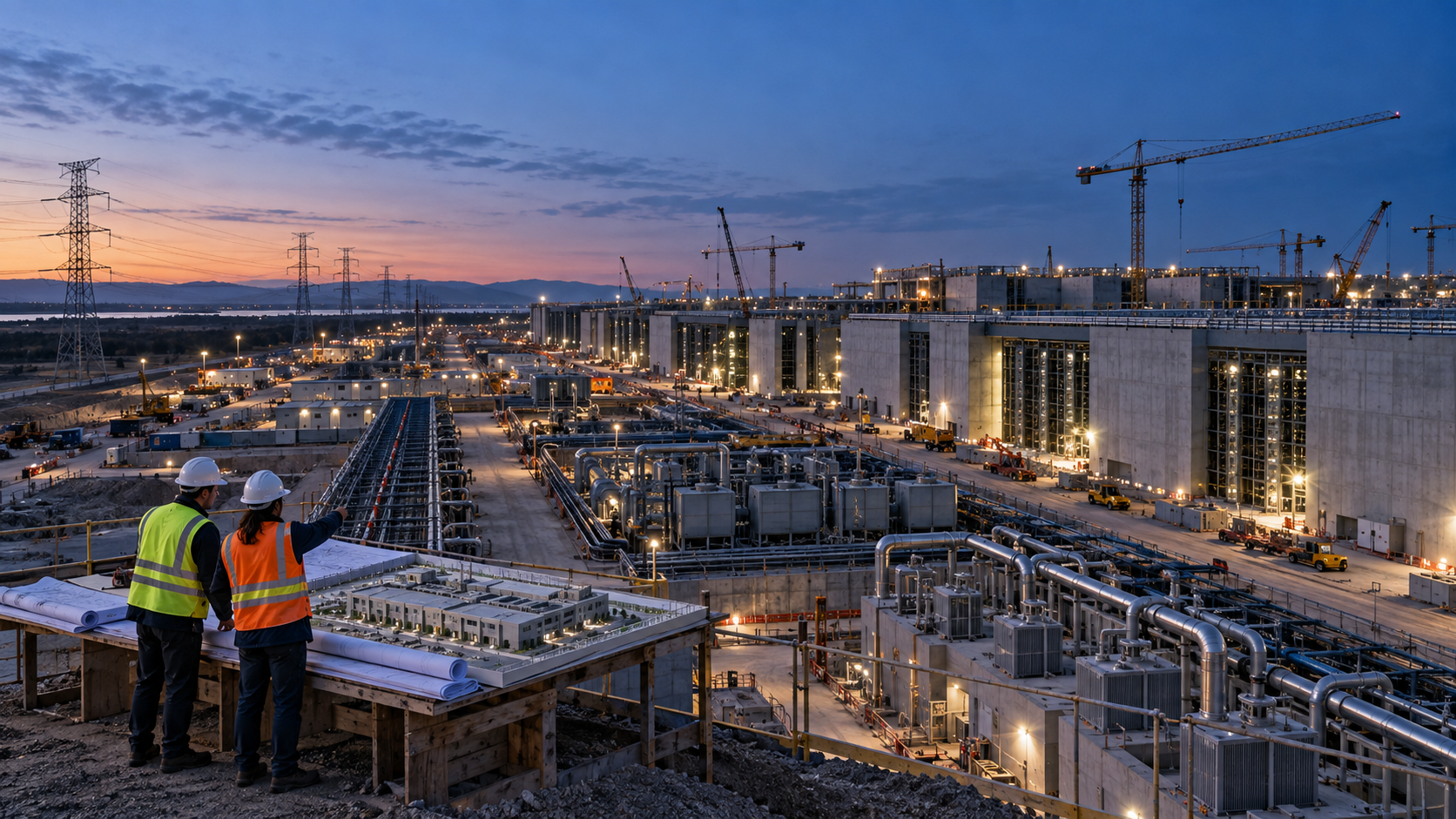
The software industry trained investors to love businesses with light balance sheets. Write code once, distribute it at negligible marginal cost, and let revenue scale faster than physical assets. Generative AI arrived wearing that familiar software costume, but the economics underneath increasingly resemble power generation, telecommunications, and heavy industry.
A modern AI service rests on long-lived commitments: land, grid connections, cooling equipment, networking, accelerators, backup power, construction labor, and contracts negotiated years before the demand is known. The interface may be a chat box, yet the wager behind it is cast in concrete and copper.
This is not simply a story about buying more chips. Compute capacity has to become an operating system of physical constraints. A site may have servers but lack available electricity. It may have electricity but face cooling limits, permitting delays, or insufficient transmission. It may be ready technically while the models it was designed for become economically obsolete. The International Energy Agency’s work on energy and AI is useful precisely because it places computing demand inside an energy system rather than treating power as an unlimited line item.
The hidden variable is utilization
Expensive infrastructure looks brilliant when it is busy. It looks disastrous when it is not. That makes utilization—not raw capacity—the central variable in AI infrastructure economics.
Training clusters generate dramatic images and large announcements, but inference demand is the harder planning problem. Consumer usage moves with product launches and fashions. Enterprise workloads may arrive slowly because integration, security review, and workflow redesign take time. Model efficiency can improve abruptly, reducing the compute required for a given result. At the same time, new reasoning techniques may consume those gains by spending more compute per request.
A datacenter financed on a smooth demand curve is therefore exposed to several discontinuities. A better model architecture can strand specialized capacity. A popular product can create a shortage in weeks. A power-price shock can ruin a seemingly safe margin. A regulatory constraint can delay a site past the useful life of the hardware ordered for it. Traditional software forecasting is poorly equipped for this combination of commodity exposure, technology risk, and construction timing.
The industry should borrow a concept from project finance: match the duration and risk of capital to the asset being built. Funding a multi-year power and datacenter commitment with assumptions derived from a fast-changing application market is a maturity mismatch. The application may pivot every quarter; the substation cannot.
Environmental accounting is operational accounting
Energy, water, and carbon reporting are often filed under corporate responsibility, as though they sit beside the business rather than inside it. For AI infrastructure, they are operating metrics. Water availability can determine where cooling is feasible. Carbon intensity can affect both customer procurement and regulatory exposure. Grid congestion can set the timetable for expansion.
Microsoft’s sustainability reporting offers one window into the tension faced by hyperscalers trying to expand cloud and AI capacity while meeting environmental commitments. The strategic lesson is broader than any one company: efficiency per computation can improve while total resource consumption rises because demand grows faster. Better chips do not automatically produce a smaller system footprint.
This creates an opening for engineering work that sounds mundane beside model research but may prove equally valuable: workload scheduling around grid conditions, heat reuse, water-aware site design, better capacity forecasting, model routing, quantization, and software that increases useful output per accelerator-hour. The winning infrastructure stack will not merely maximize tokens. It will allocate scarce physical resources to the requests that justify them.
The market will separate ownership from intelligence
Not every company needs to own the infrastructure it uses. In fact, many should avoid it. The emerging stack is likely to separate into asset owners, capacity operators, model developers, cloud platforms, and application companies, with some firms spanning several layers. Each layer has a different risk profile.
Asset owners care about contracted demand and residual value. Model developers care about rapid access to large clusters. Application companies care about reliable unit economics and the freedom to switch models. Those interests overlap, but they are not identical. A long-term capacity agreement that secures supply for a model lab may become a constraint if inference prices collapse. A vertically integrated provider may accept poor returns at one layer to defend profits at another.
Technical analysis from publications such as SemiAnalysis has become influential because chip supply, networking topology, power delivery, and model economics can no longer be understood separately. Boardrooms need the same integrated view. “AI strategy” that ignores the physical stack is now incomplete.
We expect the next industry correction to be uneven rather than universal. Scarce, well-connected facilities with flexible power and high utilization will remain valuable. Poorly located or over-specialized projects may discover that an AI datacenter is not automatically a timeless asset. The difference will be disciplined underwriting, not enthusiasm for the technology.
AI may ultimately deliver software-like abundance to users. Producing that abundance, however, is becoming a capital allocation problem of extraordinary scale. Companies that understand this will treat efficiency as strategy, capacity contracts as risk instruments, and datacenters as infrastructure projects. Those that continue to see only software margins may learn the nature of the business from the least forgiving teacher available: an expensive facility waiting for demand.
Advertisement