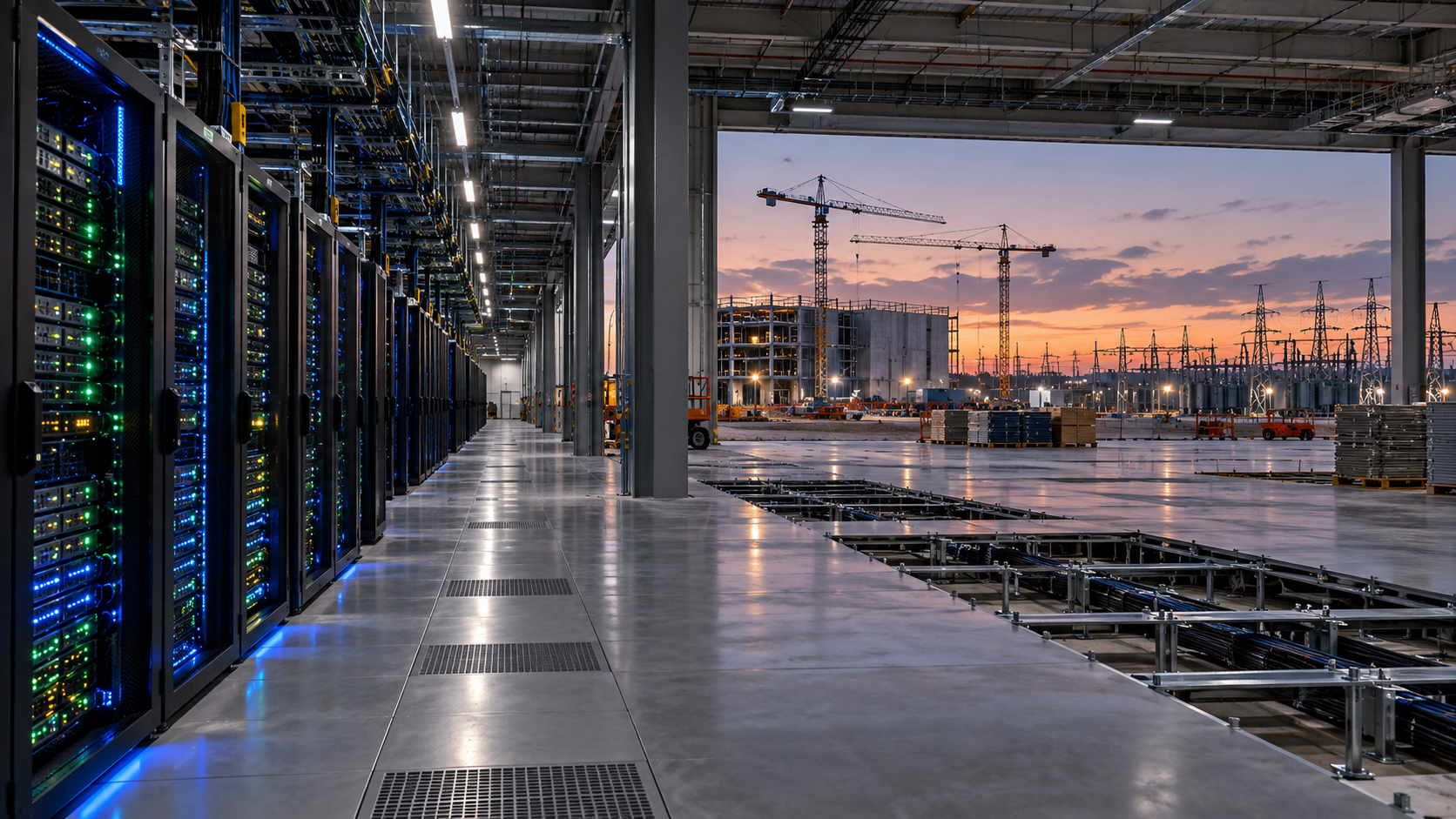
The AI business is usually narrated as a contest between models: larger context windows, better reasoning, lower token prices. Yet the decisive financial argument is moving down the stack. It sits in substations, cooling loops, accelerator leases and long-term commitments for capacity that may be obsolete before it is fully depreciated.
This changes what an AI company is. A conventional software business can add customers while its marginal infrastructure cost remains modest. An AI service may become more expensive precisely when customers use it more deeply. Long-running agents consume inference, invoke search, generate code, retry tools and preserve state. Revenue can look like software-as-a-service while cost behaves more like an industrial process.
The physical constraint is not metaphorical. The International Energy Agency’s Energy and AI report begins from the blunt fact that data centers require electricity. But “energy demand” is too abstract for operators. The practical bottlenecks are where power is available, when a grid connection can be delivered, how cooling performs under local conditions and whether expensive computing capacity stays busy enough to justify its financing.
Cheap tokens can conceal expensive products
Falling unit prices do not guarantee attractive margins. When inference becomes cheaper, developers often spend the savings on additional reasoning steps, larger contexts and more agentic behavior. Users also move from occasional queries to persistent workflows. The relevant unit of economics is therefore not cost per token. It is cost per completed, accepted outcome.
A coding agent that consumes more compute but resolves a production issue correctly may be economical. A cheap chatbot that generates work requiring human correction may not be. This sounds obvious, yet procurement and product dashboards still privilege input and output volume because those quantities are easy to meter. The industry needs to price the full loop: compute, retrieval, tool execution, review, rework and the cost of failures.
Capacity planning compounds the problem. Providers must reserve infrastructure before demand is certain. Public disclosures such as Microsoft’s investor earnings materials make clear that cloud and AI expansion now belongs in the language of capital expenditure, not merely product development. That creates a mismatch: customer preferences can change in weeks, while data centers, power contracts and depreciation schedules operate over years.
Utilization is becoming a product feature
The strongest AI products will not simply negotiate better infrastructure prices. They will shape demand. Batchable work can move to quieter periods. Small requests can route to smaller models. Cached intermediate results can prevent repeated inference. Retrieval can reduce the need to stuff entire repositories into every context window. A well-designed approval step can stop an agent before it spends twenty minutes pursuing the wrong branch.
These choices are often framed as engineering optimizations added after a prototype succeeds. That is backwards. Cost-aware orchestration belongs in product design because latency, quality and expense trade against one another at every step. Users may tolerate an overnight analysis for a lower price, but expect an interactive edit immediately. They may pay for deeper reasoning on a contract review, but not on email classification. Products should expose these service levels deliberately rather than hiding them behind one magical button.
This will also divide the market. Foundation-model providers can amortize infrastructure across many customers and products. Application companies have narrower demand but better knowledge of the workflow. Their defense is not to imitate a general model vendor. It is to use domain structure to avoid unnecessary computation: constrain possible actions, precompute stable knowledge, request human judgment at high-leverage moments and measure whether outputs survive real use.
From gross margin to consequence margin
XioX expects a more revealing metric to emerge: consequence margin. It asks how much economic value remains after the system completes a useful outcome and absorbs the operational consequences of doing so. That includes inference and infrastructure, but also verification, incident handling and customer remediation. The metric punishes products that externalize their errors onto users.
It also rewards restraint. An agent that declines an ambiguous transaction may create more value than one that proudly completes it incorrectly. A workflow that uses a modest model plus deterministic checks may outperform a frontier model asked to improvise. Architectural discipline can be a stronger margin advantage than access to the newest weights.
The industry’s loudest competition will remain at the model layer because benchmark gains are easy to announce. The quieter competition will be over power availability, utilization and the design of systems that spend computation only where it changes the outcome. AI may be sold through an interface, but its economics are increasingly settled in concrete buildings connected to the grid.
Advertisement