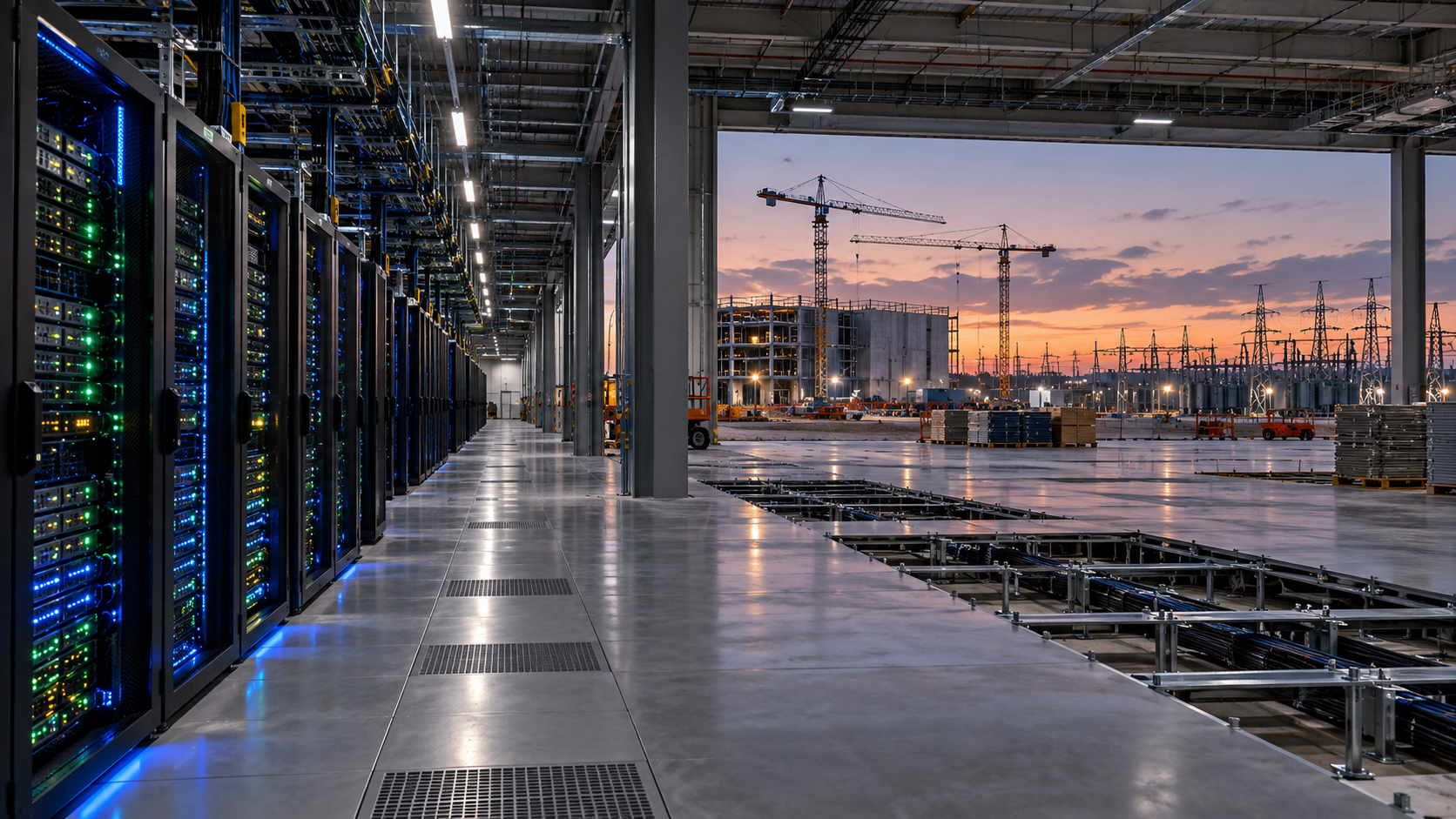
The AI industry still talks about compute as though it arrives in cardboard boxes. Order accelerators, rack them, train a model. That mental model made sense when the binding constraint was access to advanced chips. It is becoming dangerously incomplete.
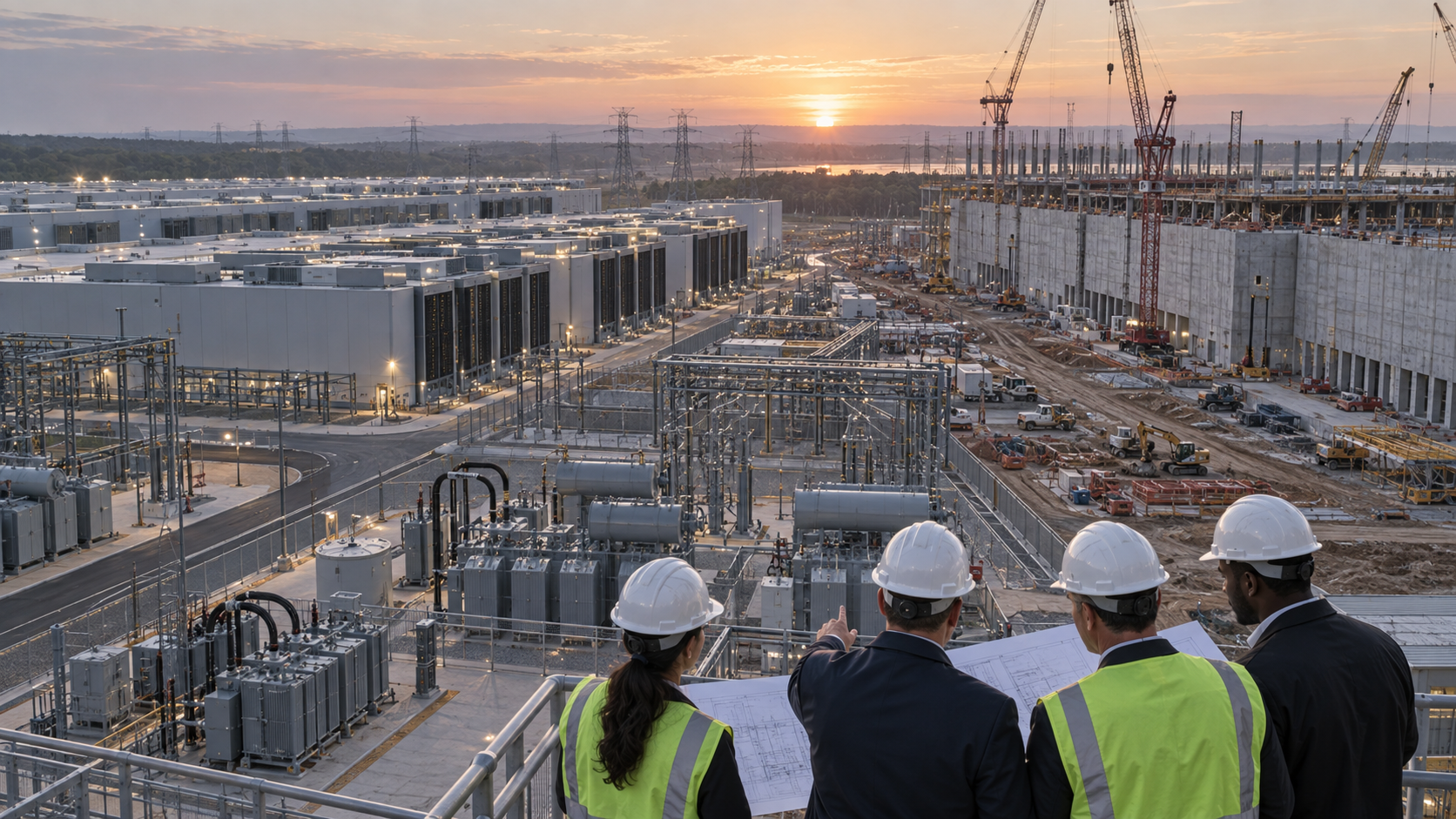
A GPU without power, cooling, networking, permits, and a commissioned building is expensive inventory. The emerging unit of competition is not the chip but the energized campus: a location where enough electricity can be delivered reliably, heat can be removed, fiber can be connected, and construction can finish before the hardware loses economic relevance.
The distinction changes how we should read announcements about AI investment. A large capital commitment is not equivalent to deployed capacity. Between the press release and the first useful token sits a chain of transformers, switchgear, substations, water systems, skilled trades, utility negotiations, and interconnection studies. Any one of them can become the schedule.
The stack now begins at the grid
Data-center engineering used to be an enabling function for software companies. For frontier AI, it is moving closer to the core product. The International Energy Agency’s work on energy and AI frames the relationship in both directions: AI infrastructure creates new electricity demand, while AI techniques may also improve energy systems. The first half of that equation is immediate. Compute capacity cannot scale independently of the physical network supplying it.
This produces a strange inversion. Software firms accustomed to deploying globally in minutes must now reason on utility and construction timelines. A model architecture can change during the time required to secure grid capacity. Hardware can advance while a site waits for electrical equipment. The result is duration mismatch: fast-moving technical assets depend on slow-moving civil infrastructure.
Companies will respond by signing longer contracts and taking more direct control of the stack. Some will finance generation, reserve power years ahead, or place facilities where energy is abundant rather than where office talent is concentrated. Others will rent capacity from specialists and accept thinner control in exchange for speed. Either way, infrastructure strategy becomes a view about future model economics, not merely a facilities decision.
Utilization will separate builders from collectors
The industry often treats installed accelerator count as a proxy for strength. That is like evaluating an airline by the number of aircraft it owns without asking how many hours they fly or whether the routes make money. The meaningful measures are utilization, useful work per watt, networking efficiency, failure recovery, and the revenue or research output produced by each deployed dollar.
High utilization is harder than it sounds. Training workloads arrive in large campaigns, inference demand fluctuates, and hardware fleets contain multiple generations with different memory and networking characteristics. A cluster can be nominally full while wasting capacity through data stalls, communication overhead, fragmented reservations, or jobs that could have run on cheaper machines.
This is where systems engineering becomes strategy. Improvements in kernels, scheduling, quantization, caching, and model routing may create capacity faster than a new building. NVIDIA’s technical developer blog documents the continuing effort required to translate theoretical hardware throughput into application performance. The commercial lesson is broader: owning scarce hardware is not the same as operating it well.
Smaller AI companies should resist copying frontier labs’ infrastructure posture. Their advantage rarely comes from reproducing the largest training cluster. It comes from selecting where bespoke compute matters and renting the rest. A focused company may create more value with disciplined inference economics, proprietary workflow data, and fast product iteration than with an impressive but underused fleet.
The balance sheet is part of the architecture
AI systems now bind software design to financing decisions. A team choosing a larger model is also choosing a serving-cost curve. A company reserving years of capacity is making a demand forecast. A builder selecting a site is taking positions on energy prices, regulation, water availability, and community acceptance.
Those decisions introduce asset risk. Accelerators depreciate economically as new generations arrive. Buildings and grid connections last much longer. The useful life of each layer differs, so the system should be designed for replacement rather than imagined as one permanent machine. Modular power and cooling, adaptable network fabrics, and heterogeneous scheduling are not simply technical niceties; they are ways to keep long-lived infrastructure valuable as short-lived compute changes.
Investors should likewise distinguish between durable bottlenecks and temporary scarcity rents. A supplier can enjoy extraordinary demand because one component is briefly constrained, then face normalization when capacity catches up or architectures shift. Specialist analysis from publications such as SemiAnalysis is valuable precisely because semiconductor supply chains, networking, packaging, and data-center design must be understood together rather than as isolated markets.
The social contract around infrastructure will matter too. A project competing for power or water cannot be justified solely by the market capitalization of its tenants. Developers will need credible answers about grid investment, local employment, resilience, and environmental cost. Communities can tell the difference between shared infrastructure and an enclosed industrial island.
The AI infrastructure contest is therefore not a simple spending race. It is a coordination test across technology, capital, energy, construction, and public legitimacy. Chips remain essential, but the scarce capability is increasingly the ability to assemble everything around them. The winners will not be the companies that announce the most compute. They will be the ones that convert physical capacity into dependable, economically useful work before the assumptions behind the project expire.
Advertisement