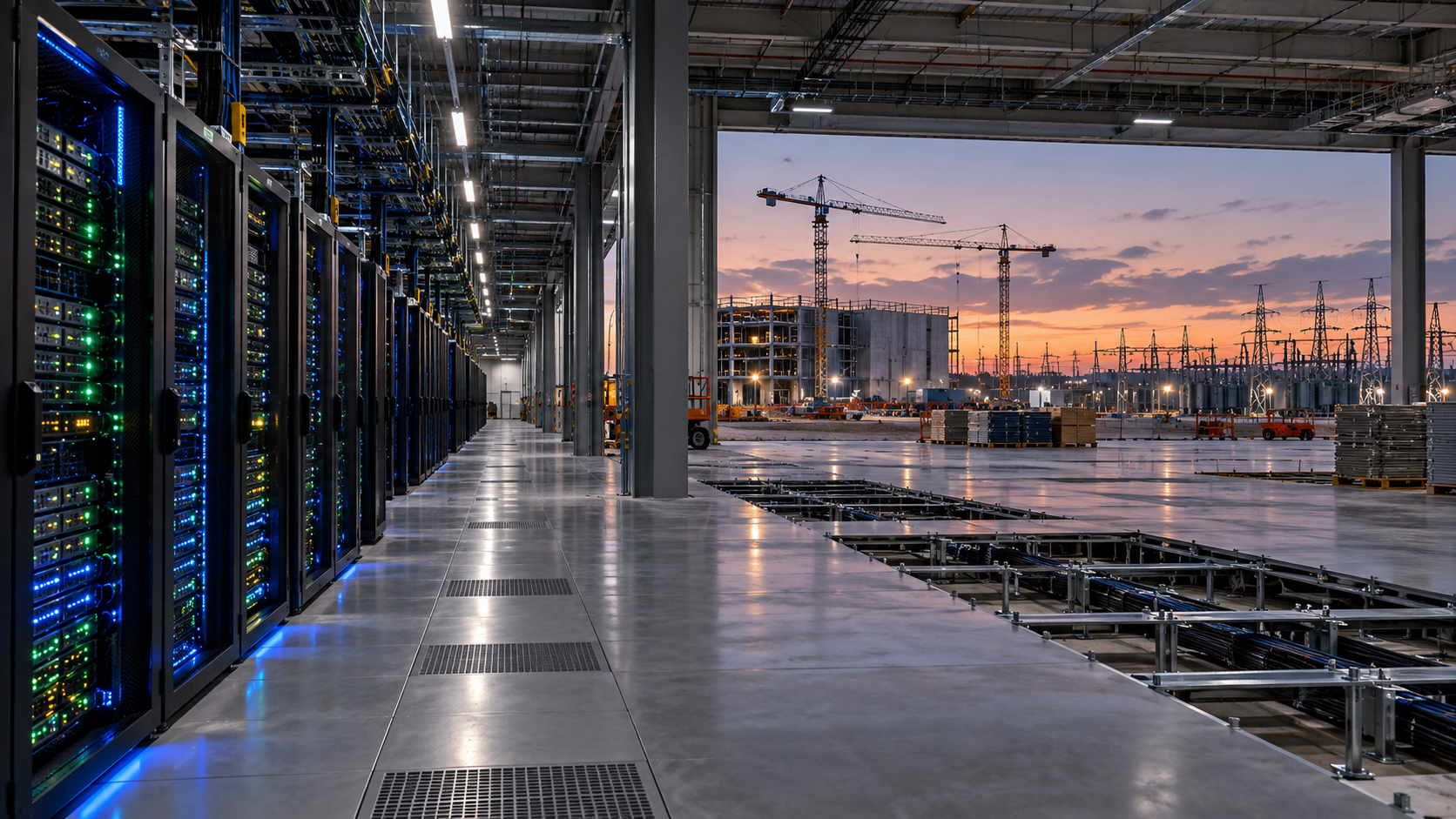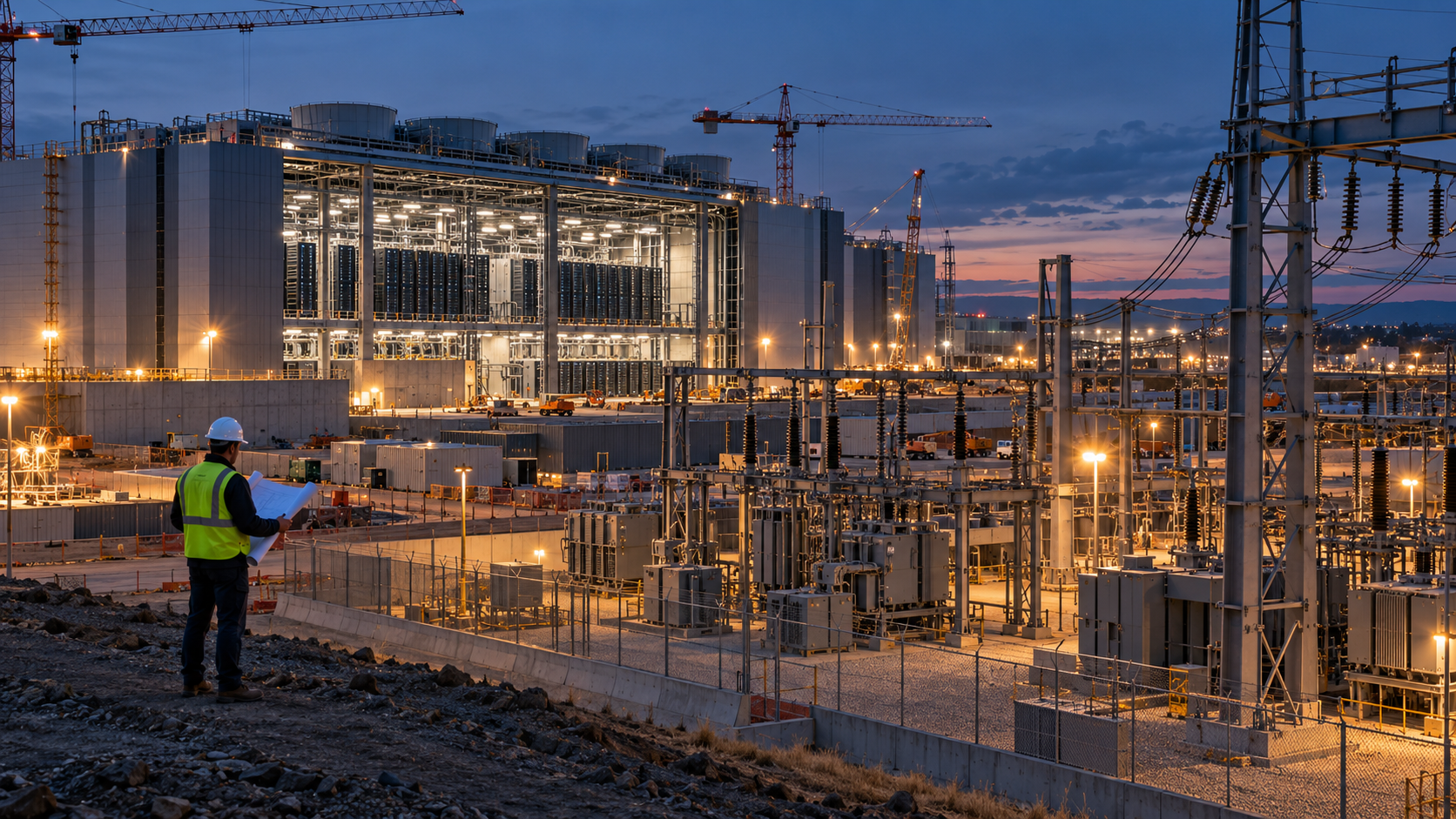
The popular picture of AI infrastructure begins and ends with a rack of accelerators. That picture is now dangerously incomplete. A chip can be ordered in a quarter; the electrical capacity, interconnection, cooling system, permits, and construction labor required to use it may take far longer to assemble.
AI is becoming an infrastructure business in the older sense of the word: dependent on land, power plants, transmission lines, transformers, water strategies, debt structures, and local political consent. Software remains the reason for the investment, but steel and electrons increasingly determine its schedule.
The International Energy Agency’s Energy and AI report places data centers within the broader electricity system rather than treating them as unusually large office buildings. That framing is correct. Once a proposed campus draws power on the scale of heavy industry, its commercial prospects depend on regional generation and grid conditions. Model demand can be global; electricity constraints are stubbornly local.
This creates a mismatch at the heart of the AI economy. Product teams iterate weekly, chip road maps advance annually, and major energy projects move on timelines measured in years. The hardest planning problem is not predicting whether models will improve. It is deciding how much durable physical capacity to build before demand, hardware efficiency, and product economics settle.
Utilization is the hidden balance sheet
Scarcity encourages a simple strategy: acquire as much compute as possible. Yet ownership and productive use are different achievements. A cluster that is waiting on power, networking, storage, software integration, or customer demand is not a strategic asset in practice. It is depreciating equipment.
Utilization will separate strong infrastructure operators from enthusiastic buyers. That means scheduling mixed workloads, reducing idle gaps between training runs, improving inference batching, matching model sizes to tasks, and designing products that can tolerate variable capacity. Seemingly modest software efficiencies can have financial consequences because they change how much revenue a fixed electrical envelope can support.
The same logic complicates hardware comparisons. Performance per accelerator is useful, but performance per megawatt, per dollar of total facility cost, and per month of deployment delay may be more decisive. The relevant system includes networking, memory, cooling, power conversion, and orchestration. Specialist analysis from publications such as SemiAnalysis has helped move the industry conversation toward these system-level constraints.
This is why inference deserves more attention than glamorous training runs. Training creates a model at intervals. Inference serves every interaction, continuously. A product that gains users can turn a technical success into an operating-cost problem. If revenue per query does not comfortably exceed the fully loaded cost of serving it, scale amplifies the flaw.
The financing model will shape the technology
Infrastructure is never financially neutral. A company that commits capital to facilities with long useful lives makes assumptions about future workloads. Those assumptions quietly influence engineering decisions. Hardware diversity becomes inconvenient. Smaller models may look less attractive if an organization must keep a large fleet busy. Capacity contracts can encourage consumption even when architectural restraint would be wiser.
Conversely, dependence on rented compute transfers some risk while introducing exposure to supplier pricing and availability. Neither strategy is inherently superior. The danger is pretending that infrastructure commitments do not constrain the product road map.
We expect more AI companies to adopt a portfolio approach: reserved capacity for predictable baseline demand, elastic capacity for peaks, specialized hardware where workloads justify it, and aggressive optimization before new construction. Model routing will become part of finance. Sending every request to the largest available model will eventually look as crude as running every database query on the most expensive machine.
Power sourcing will also become a competitive variable. The IEA’s analysis of energy supply for data centers shows that additional demand will be met by a mix of renewables, gas, coal, and eventually more nuclear generation, with substantial regional variation. The carbon and reliability profile of an AI service will therefore depend partly on where and when computation occurs.
The local bargain cannot be an afterthought
Data centers bring investment and tax revenue, but they also compete for electrical capacity, equipment, land, and sometimes water. Communities will reasonably ask who pays for grid upgrades, who bears reliability risks, and how many lasting jobs remain after construction. “AI progress” is not an adequate answer to a household worried about utility bills or an industrial customer waiting for an interconnection.
Developers that engage these questions early will have an advantage. Transparent demand forecasts, flexible-load agreements, investment in new generation, heat reuse where practical, and credible water plans can turn a contested project into a durable local bargain. Treating public acceptance as a communications exercise will produce delays that no quantity of accelerator purchase orders can fix.
At XioX, we see a strategic correction coming. The winners of the next infrastructure phase will not simply be the companies with the largest announced capital budgets. They will be the ones that turn constrained megawatts into reliable, valuable work while retaining the flexibility to adopt better hardware and smaller models. In AI, abundance at the chip level can still be defeated by scarcity everywhere else.
Advertisement