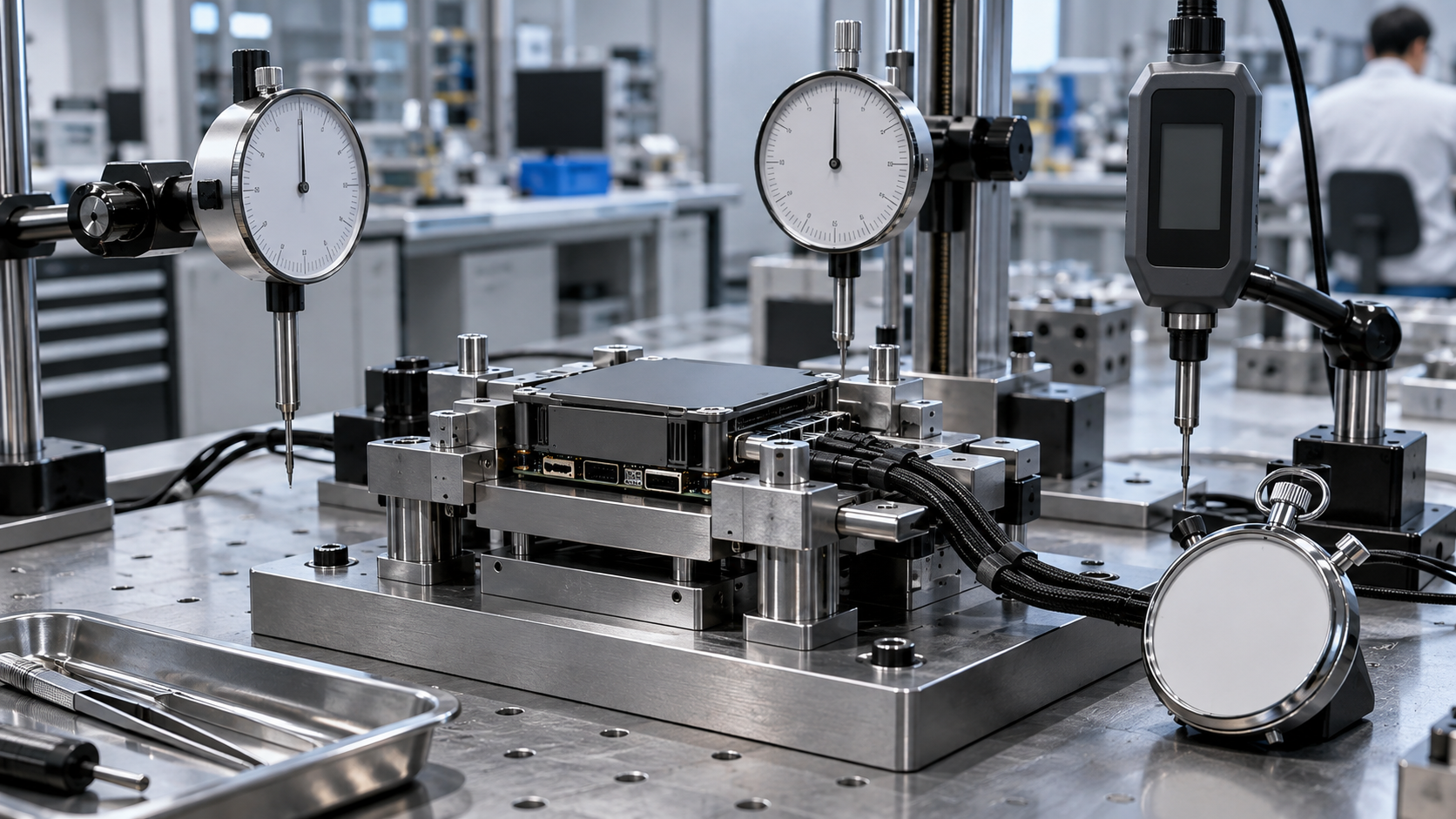
Every few weeks, a new model tops a leaderboard, a Twitter thread declares a paradigm shift, and product teams face the same tedious question: do we re-evaluate our whole stack again? For a while, the answer was reflexively yes. Benchmarks were treated as a reasonably direct proxy for which model to build on, and switching costs were assumed to be low enough that chasing the top of a leaderboard was a defensible strategy.
That assumption has aged badly, and most experienced teams have quietly stopped operating on it. The problem is not that benchmarks are meaningless. It is that public benchmarks measure general capability on tasks designed to be broadly representative, while production reliability depends on performance on your specific task, with your specific data, under your specific latency and cost constraints. A model that improves two points on a general reasoning benchmark can perform identically, better, or worse on your actual workload, and there is no way to know which without testing it yourself.
The Harness Is the Product, Not the Model
The teams shipping AI features reliably in production have converged on a different discipline: building an evaluation harness specific to their own task, and treating it as core infrastructure rather than a one-time due-diligence step before launch. A harness in this sense is a curated, versioned set of real or realistic inputs from your domain, a scoring method appropriate to your task, whether that is exact match, a rubric graded by another model, or a human review sample, and a pipeline that can run any candidate model or prompt change against that set and produce a comparable score.
Once that exists, the question stops being "is the new model better on the public leaderboard" and becomes "does the new model score better on our harness, and by how much, and at what cost and latency delta." That is a dramatically more useful question, and it is answerable in an afternoon instead of a multi-week re-integration project. It also catches regressions that public benchmarks structurally cannot, because a model can genuinely improve on broad reasoning while regressing on a narrow formatting requirement or a domain-specific instruction that only your task depends on.
Building this kind of harness is unglamorous work compared to the excitement of a new model release, which is probably why it gets underinvested relative to its payoff. It requires someone to sit down and actually decide what "good" means for a specific feature, collect enough representative examples to make the score meaningful, and maintain the set as the product evolves. But the payoff compounds. A team with a solid harness can evaluate a new model, a new prompt, or a new retrieval strategy in hours and ship the change with confidence. A team without one is stuck re-litigating the same debate about whether a change helped every time, usually based on a handful of anecdotal examples someone happened to notice.
There is a broader lesson in here about where durable advantage actually sits in AI products right now. The underlying model layer is genuinely getting commoditized at the margins, with multiple vendors clustered close together on most general capability measures. What is not commoditized is the quality of a team's own evaluation infrastructure, its ability to measure what actually matters for its users, and its discipline about shipping only changes that measurably help on that specific measure. XioX's view is that this is one of the more durable, boring truths in a market that otherwise moves too fast to have many of them: the harness ages better than the hype, and teams that invest in it stop being at the mercy of whichever leaderboard is trending this week.
Advertisement