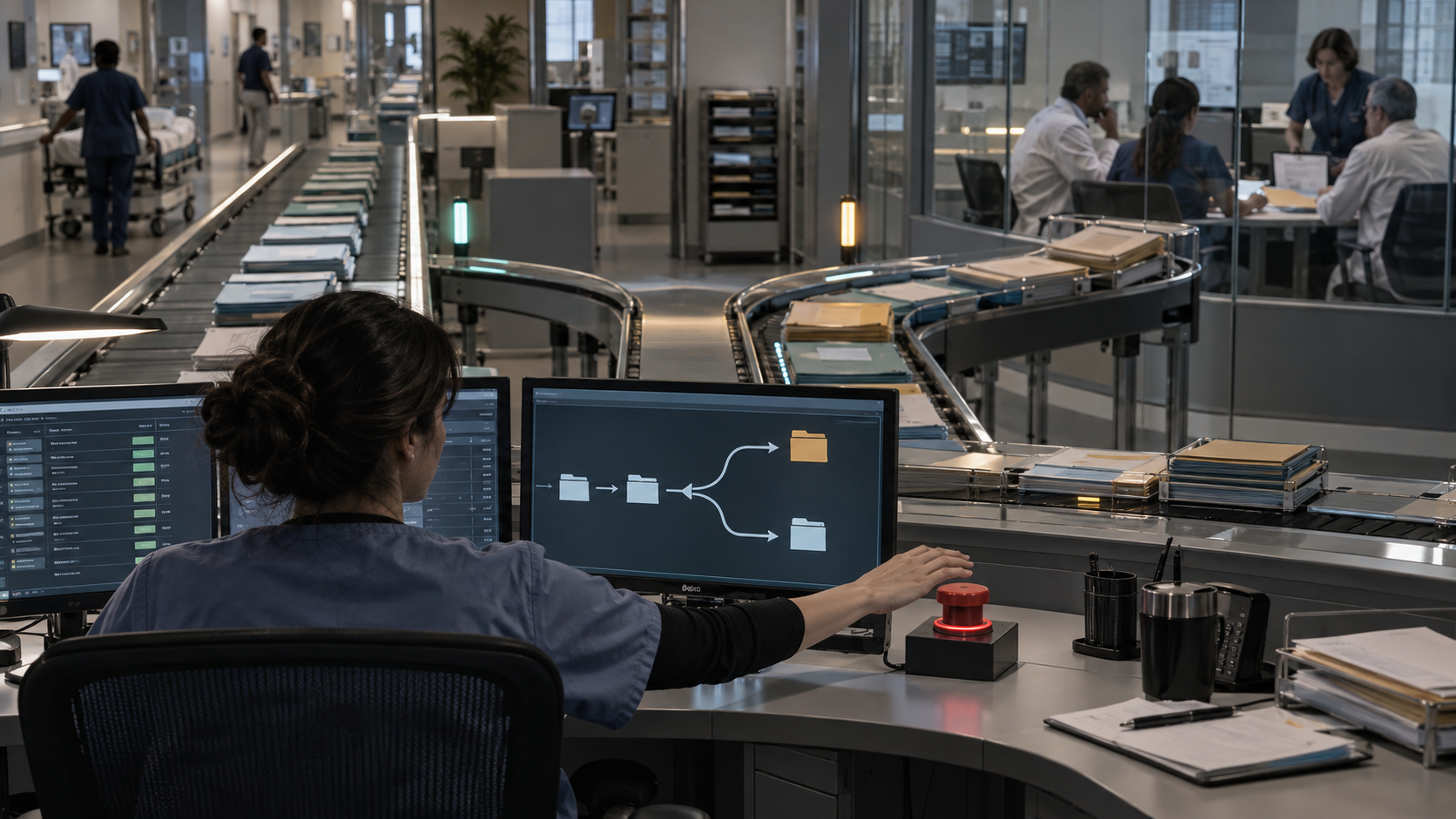
“A human reviews the output” has become one of the most comforting sentences in AI product design. It appears in risk assessments, sales conversations, and launch plans as if the presence of a person transforms an uncertain system into a controlled one.
Often it does not. A reviewer may see hundreds of recommendations, have seconds to inspect each one, and face subtle pressure to approve the machine. They may lack access to the source material, have no way to express uncertainty, or be unable to stop the workflow. In that arrangement, the human is not a safeguard. The human is where the system deposits responsibility.
Effective oversight requires more than putting someone between prediction and action. It requires an engineered relationship among model behavior, interface design, staffing, escalation authority, and organizational incentives. Remove any one of those pieces and “human in the loop” becomes a slogan.
Reviewers need a reason to disagree
Automation changes human attention. When a system is usually right, checking it becomes monotonous; when it is frequently wrong, checking it becomes exhausting. Either condition can degrade review. A person shown a polished recommendation without contrary evidence will tend to treat approval as the default path, especially when queues and performance targets reward speed.
A serious review interface should not merely present the model’s answer. It should expose the material facts needed to make an independent judgment. It should distinguish retrieved evidence from generated interpretation, surface missing information, and make disagreement cheap. In high-stakes settings, the reviewer may need a second view generated without seeing the model’s conclusion first.
The NIST guidance on human-AI interaction makes a crucial point: systems can range from fully autonomous to fully manual, and human roles must be clearly defined. The practical implication is that oversight cannot be copied from one use case to another. Reviewing a marketing draft and approving an insurance denial are not variations of the same control.
Design the escalation path before the model
Teams typically optimize the normal case first. They tune prompts, evaluate accuracy, and connect tools. Escalation is added near launch as a queue labeled “needs review.” This sequence is backward for consequential automation. The exception path defines the safe operating envelope and should shape the system from the beginning.
Every deployment needs explicit answers to a few operational questions. What causes automatic deferral? Who receives the case? What context arrives with it? How long can it wait? Can the reviewer pause related actions? What happens when reviewers disagree? Which events trigger investigation rather than individual correction?
These are software questions as much as policy questions. A reviewer cannot exercise authority that the interface does not implement. If the only buttons are approve and reject, the organization has erased defer, request evidence, narrow scope, and stop the system. Governance written in a document is inert until it appears in permissions, states, logs, and controls.
The broader NIST AI Risk Management Framework treats governance as an ongoing function across the system lifecycle. That is a stronger model than a one-time launch review. AI behavior shifts when models change, tools are added, users adapt, or the distribution of cases moves. Oversight must observe these changes and alter the operating boundary accordingly.
The right to pause is infrastructure
Many organizations define who may approve an automated decision but not who may suspend automation itself. That omission matters. Frontline reviewers often notice emerging failure patterns first: a new document format, a policy change, a repeated hallucinated field, or a cluster of strange edge cases. If they can only correct cases individually, the same failure continues upstream.
A real control system gives designated people the ability to slow, narrow, or stop automation without beginning an executive incident each time. The mechanism can be graduated. A reviewer might route a category to manual handling, reduce an agent’s transaction limit, disable one tool, or require a second approval. The point is not to create a theatrical red button. It is to make reversibility part of normal operations.
Pause authority also clarifies accountability. When no one can halt a system, everyone can claim they assumed someone else was monitoring it. When authority is explicit and logged, organizations can train for it, test it, and examine whether incentives discourage its use.
Measure the human system
Model dashboards track latency, token use, tool errors, and evaluation scores. Oversight deserves equally concrete metrics. How frequently do reviewers overturn recommendations? How often do they request additional evidence? Which case types consume the most time? Do overrides cluster after a model update? Are reviewers rubber-stamping during peak demand? How many escalations return without a usable resolution?
A low override rate is not automatically evidence of quality. It could indicate excellent predictions, poor reviewer attention, or an interface that makes disagreement costly. Metrics require interpretation, sampling, and occasional independent audits. Still, an imperfect measurement of oversight is better than assuming that a named reviewer makes the system safe.
The most honest product question is not whether a human is somewhere in the loop. It is whether that person has the information, time, incentives, and technical authority to change what happens next. If the answer is no, the loop is decorative. If the answer is yes—and the organization tests that capability under pressure—human judgment becomes what it should have been all along: production infrastructure.
Advertisement