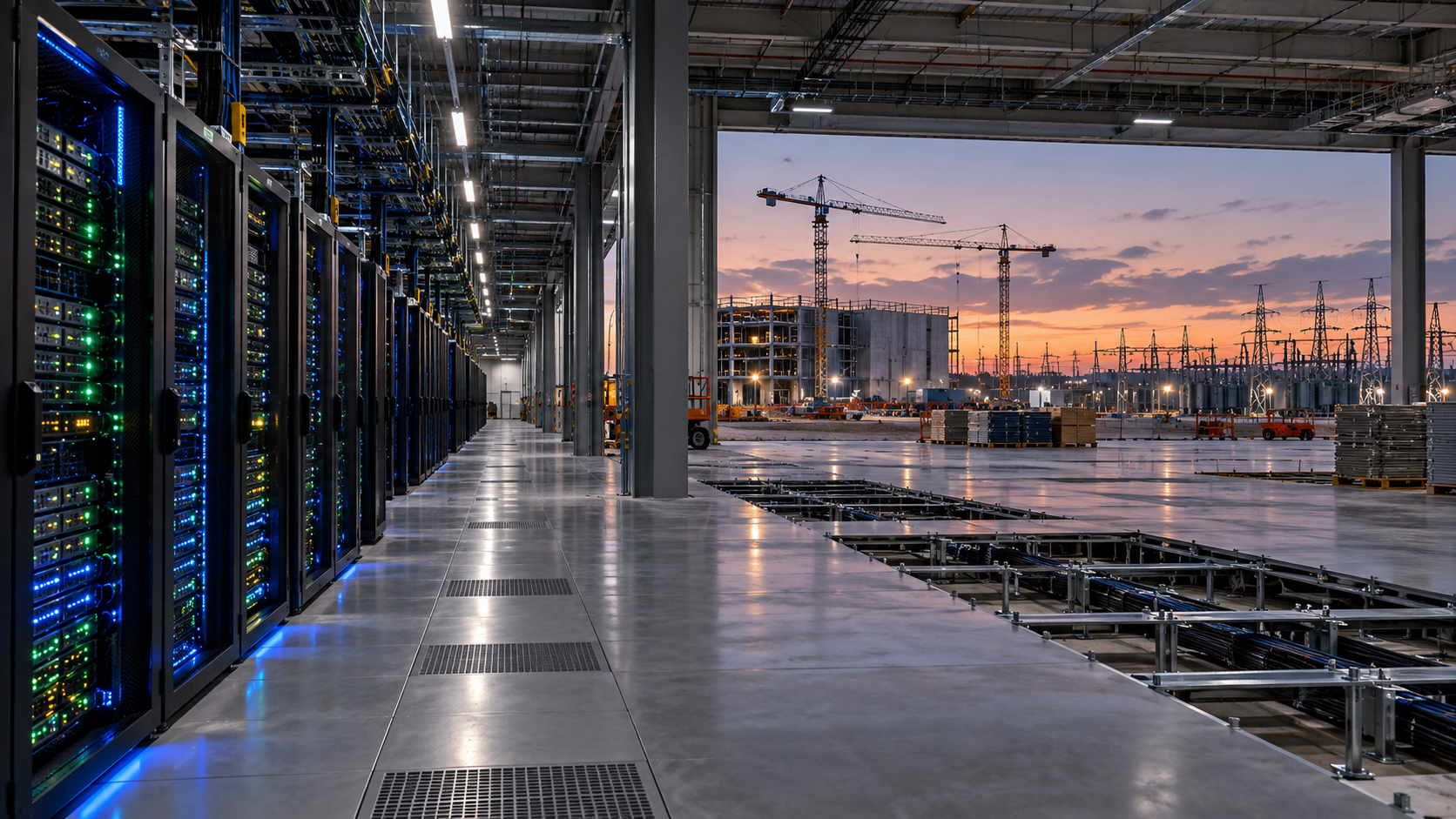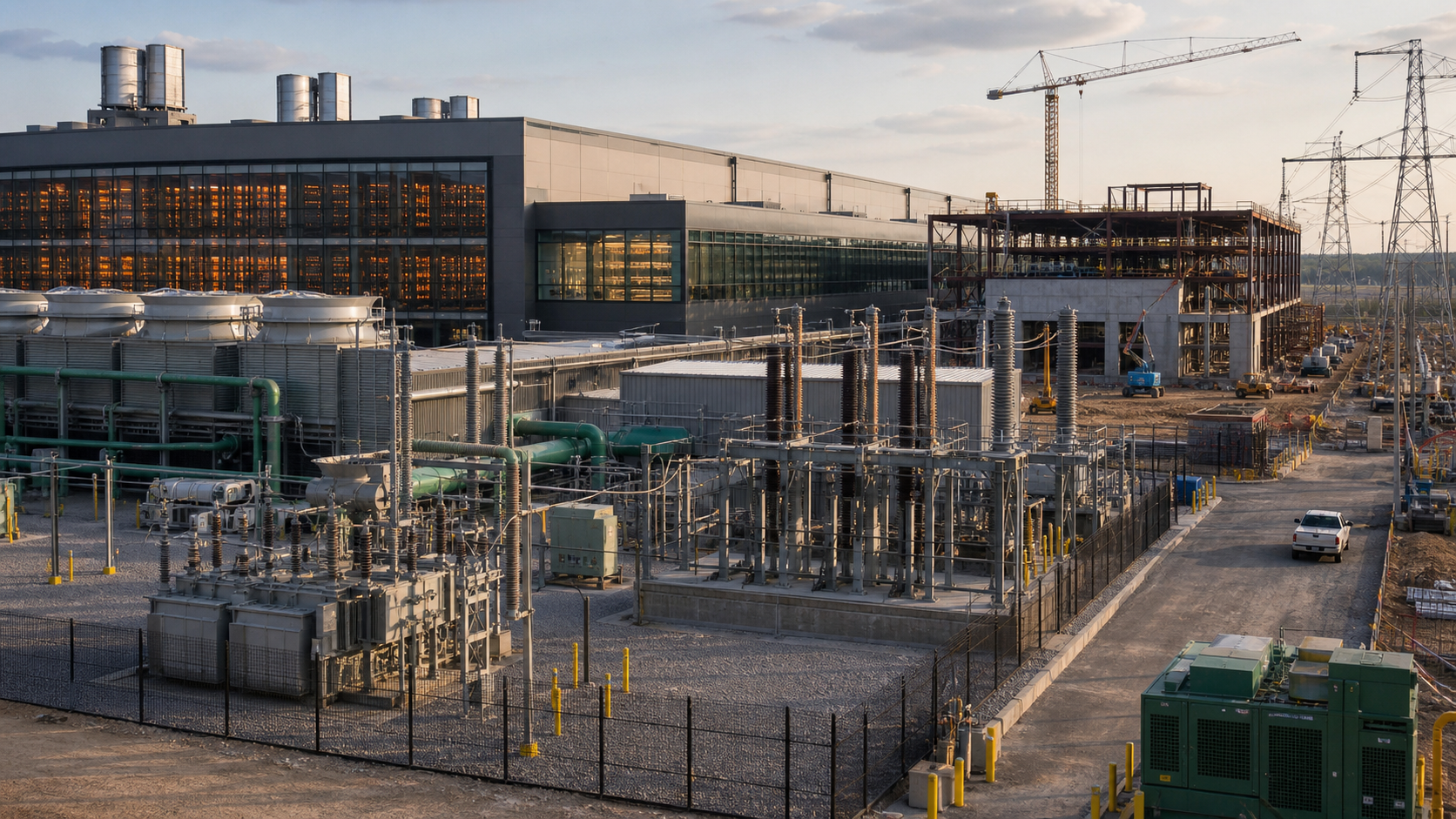
The public story of AI is still dominated by model launches, leaderboards, and product demos. The private story is increasingly about substations, cooling loops, fiber routes, procurement cycles, and debt. That is not a side plot. It is the plot. As AI systems become more capable and more widely deployed, the industry’s real bottleneck is drifting away from cleverness and toward industrial capacity.
You can hear it in how major companies talk when they speak to builders rather than to the broader public. At Google Cloud Next 2026, the tone was not “here is one magical model that solves everything.” It was platform language: chips, throughput, agents, orchestration, and the machinery required to operationalize them. The same pattern shows up in older but still revealing infrastructure writing such as Meta’s overview of how it is rebuilding its backbone for the AI age. Strip away the branding and a blunt reality appears: frontier AI is becoming an infrastructure business as much as a software business.
That matters because infrastructure businesses obey different laws than software businesses. Software can often scale through distribution. Infrastructure scales through permits, steel, transformers, networking gear, land, and long lead times. Software engineers are trained to think in sprints and deploy cycles. Utilities and construction markets think in years. AI companies now live in both clocks at once, which creates a strategic tension the industry still understates.
The Stack Has Hit the Physical World
For years, the most seductive argument in software was that bits float above atoms. AI is puncturing that illusion. Training clusters need enormous amounts of hardware in one place. Inference at mass scale needs reliable power and predictable cost curves. Cooling is not an implementation detail when the density of compute keeps climbing. Interconnects are not boring plumbing when latency between chips shapes what systems are economically possible. Once those constraints bite, the conversation changes from “Which model is best?” to “Which business can keep feeding the machine?”
This is why the market’s fixation on model rankings can miss what is structurally happening. A lab can ship a remarkable model and still be strategically exposed if it cannot sustain the compute footprint to serve demand, iterate quickly, and price competitively. Conversely, a company with a slightly less glamorous model may be better positioned if it owns distribution, enterprise trust, power contracts, or custom silicon. The frontier is no longer a pure research contest. It is a coordination contest across engineering, finance, and operations.
There is a familiar historical pattern here. Industries often begin with a burst of invention and then harden around supply chains. Railroads did not become important because locomotives were intellectually elegant; they became important because rights-of-way, capital formation, and network effects locked in advantage. Electrification was not won by the prettiest dynamo. Cloud computing did not mature when virtualization became conceptually persuasive. It matured when providers built enough dependable infrastructure that customers could reorganize around it. AI is entering that stage now.
That does not mean algorithms stop mattering. They matter enormously. Better models reduce waste, improve utilization, and unlock new categories of demand. But the industry is slowly discovering that algorithmic progress and infrastructure pressure compound each other. Every improvement that makes AI more useful also creates more appetite for inference, more demand for deployment, and more urgency around the physical stack beneath the software. Success creates new scarcity.
Investors and operators should pay attention to what kinds of companies become strategically central in that environment. It is not just model vendors. It is data center developers, utilities, chip designers, networking providers, cooling specialists, and software platforms that make expensive compute more accountable. The winners may look less like pure SaaS darlings and more like hybrid industrial companies with unusually strong developer relations.
There is also a cautionary note here. When the core constraint becomes power and capital, incumbency tends to thicken. That can reduce openness even if open models continue to improve. The nominal availability of model weights does not eliminate the advantage of organizations that can buy time on the grid, lock down supply chains, or absorb years of infrastructure spend before returns fully materialize. In that sense, the next phase of AI may be more materially concentrated than the rhetoric of democratization suggests.
For customers, this shifts the due diligence question. It is not enough to ask whether a vendor has an impressive demo or a credible roadmap. Ask whether the vendor can sustain service quality when demand spikes. Ask how exposed they are to third-party infrastructure bottlenecks. Ask whether their economics depend on assumptions about falling compute costs that may not arrive on schedule. Ask whether they understand AI as a feature set or as an operational discipline.
XioX’s view is that the market has not fully repriced this reality. AI still gets valued like software at the moment when much of its moat is being forged in the economics of industrial systems. That does not make the opportunity smaller. It makes it harder, slower, and more consequential. The companies that thrive will not just have good models. They will have the patience and competence to build around them like utility operators with product instincts. That is a rarer combination than the industry likes to admit.
Advertisement