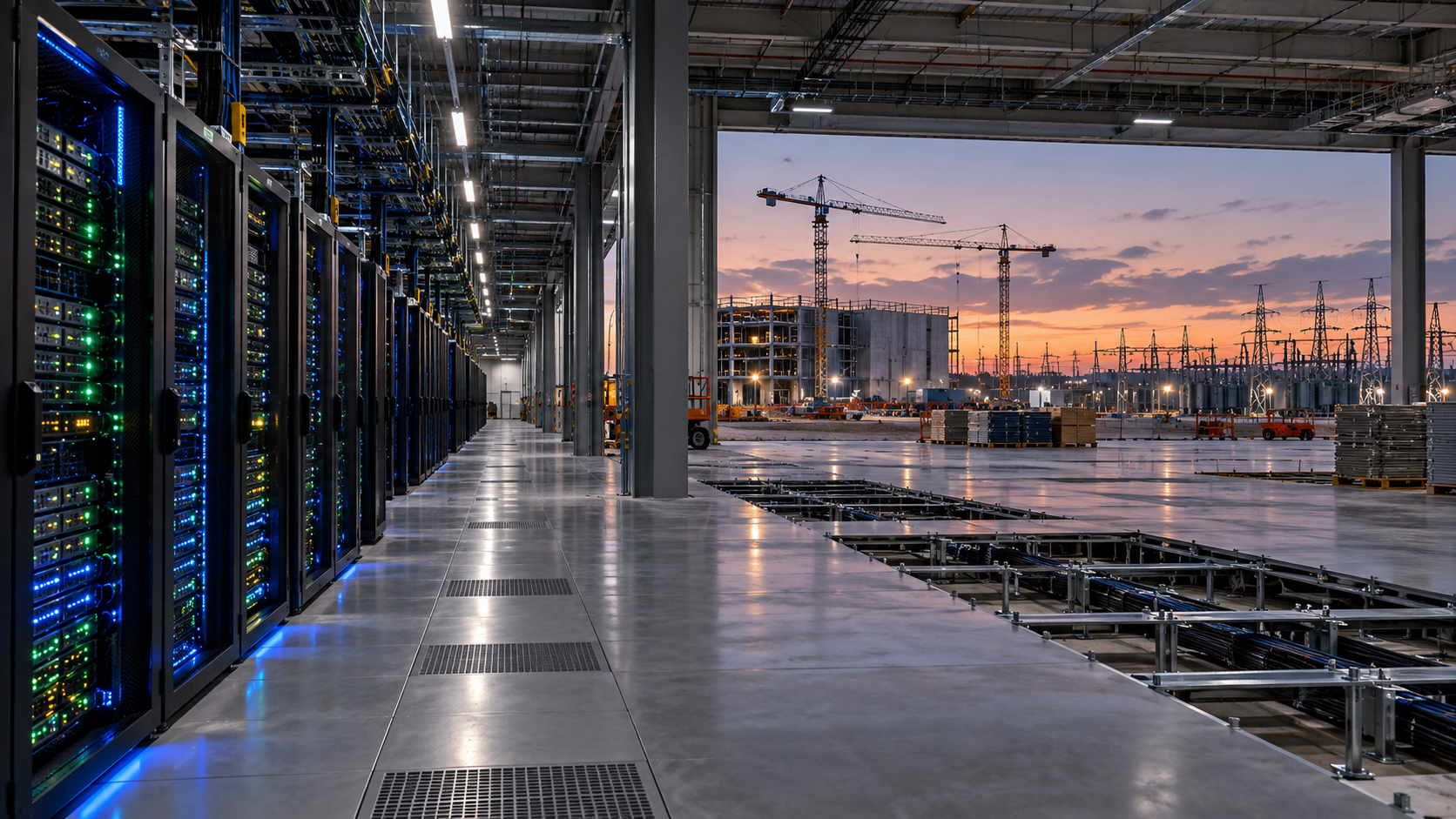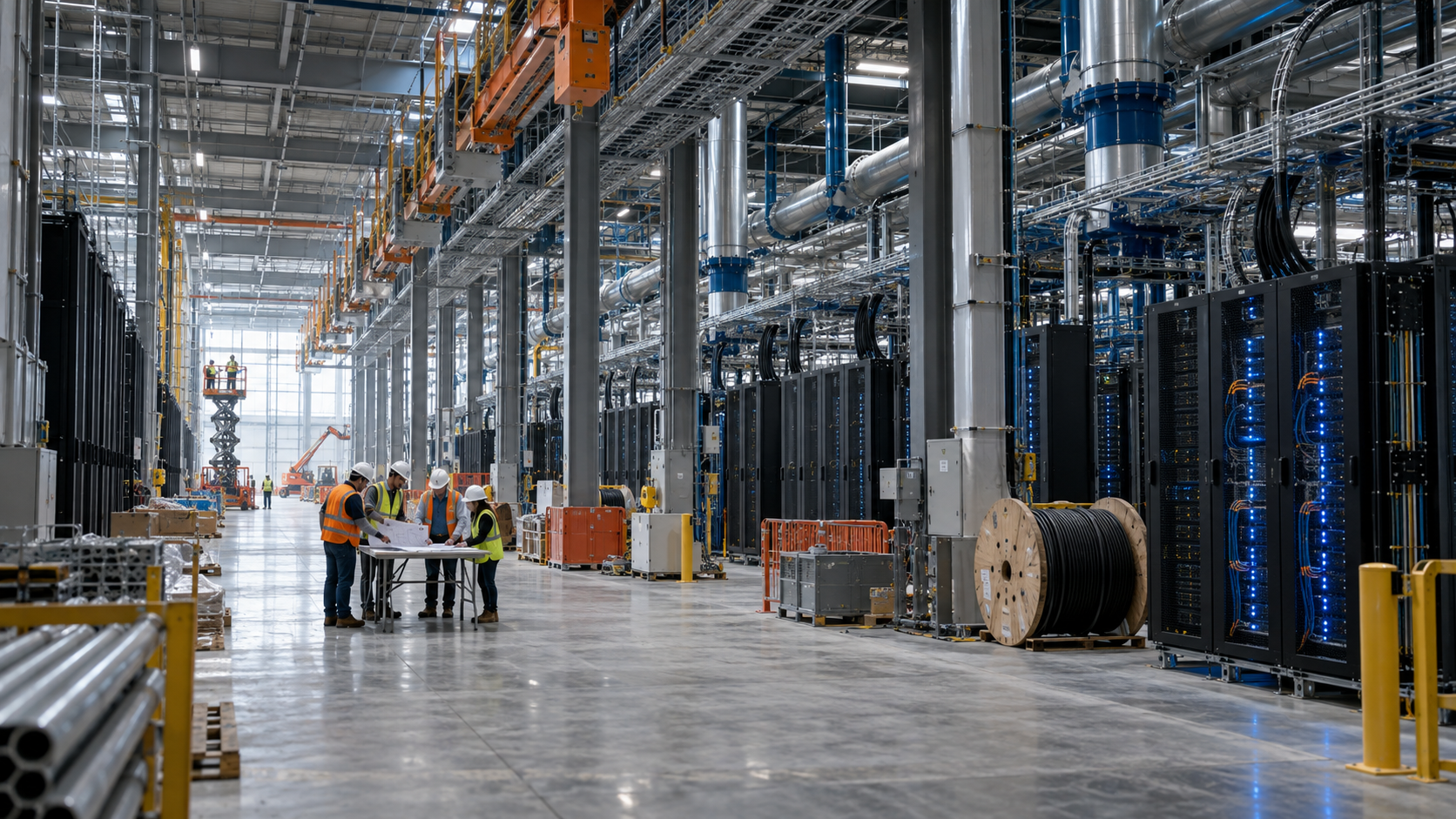
The AI industry talks about compute as if it were a simple input: acquire more accelerators, train larger systems, serve more users. That vocabulary hides the character of the bet. A modern AI data center is not a software feature that can be rolled back after a disappointing quarter. It is a bundle of land, grid access, transformers, cooling systems, networking equipment, construction contracts, and specialized chips—assembled years before anyone can know exactly what workloads it will run.
The central risk is not that companies will fail to obtain enough compute. It is that they will build the wrong capacity at the wrong time.
This distinction matters because demand forecasts contain several uncertainties that reinforce one another. Model usage may grow, but inference could become dramatically more efficient. Customers may adopt agents, but their willingness to pay for sustained autonomous work remains uneven. New hardware may lower the cost of a unit of intelligence while making the previous generation less competitive. A facility can be fully occupied in a physical sense and economically idle because its output costs too much.
Compute is becoming an infrastructure portfolio
Cloud companies already understand capital planning, but AI changes the shape of it. Training produces enormous, concentrated bursts of demand. Consumer inference rewards geographic distribution and low latency. Enterprise workloads may require data residency, predictable capacity, or isolation. Agentic systems add long-running, irregular jobs whose resource needs are harder to forecast than a conventional API call.
These are not interchangeable loads. A company that describes them all as “GPU demand” is managing inventory, not infrastructure.
The physical constraints are equally specific. The International Energy Agency’s Energy and AI report estimates that data centers consumed roughly 415 terawatt-hours of electricity globally in 2024 and projects substantial growth through the end of the decade. The aggregate number is striking, but the local problem is more consequential: data centers concentrate demand where transmission capacity, generation, permitting, and water may already be constrained.
A signed chip order does not produce usable compute if energization slips. Nor does cheap land compensate for a weak network route or an inflexible utility agreement. The scarce asset is increasingly not the accelerator itself but a coordinated site where power, cooling, connectivity, and equipment become available on the same schedule.
The utilization metric can lie
Executives naturally watch accelerator utilization, yet a high percentage can conceal poor economics. Teams can keep hardware busy with speculative experiments, low-value internal jobs, or workloads that would run more cheaply elsewhere. Technical utilization measures activity; it does not measure the value created per unit of constrained power and capital.
A better operating view separates at least four questions: Is the hardware active? Is it running the workload it was designed for? Is that workload producing revenue or strategic learning? Could the same outcome be achieved with less expensive capacity?
This is where software architecture becomes capital allocation. Better batching, quantization, caching, routing, and workload scheduling do more than cut a cloud bill. At sufficient scale, they defer construction. An engineering team that doubles useful inference per watt may create more enterprise value than one that secures another building full of hardware.
Efficiency also creates a familiar economic tension: cheaper intelligence can stimulate more usage. That does not make optimization futile. It means companies must decide where the resulting capacity goes instead of assuming every saved unit will reduce total consumption.
Build options, not monuments
The industry’s largest infrastructure programs are often presented through headline commitments. OpenAI’s Stargate announcement, for example, reflects the scale at which leading labs and partners now think about domestic AI capacity. The strategic question beneath any such program is how to preserve options while building assets with long lead times.
Modular deployment is one answer: stage power delivery, standardize repeatable blocks, and tie later phases to observed demand. A mixed hardware fleet can reduce dependence on one roadmap, provided the software layer can schedule across it without imposing crippling complexity. Long-term energy contracts can stabilize supply, but they should be evaluated against workload flexibility and the risk that a site becomes technologically stranded.
Businesses purchasing AI capacity face a smaller version of the same decision. Reserved capacity can look prudent during scarcity, but it transfers utilization risk to the buyer. Before signing a long commitment, leaders should know which workloads are steady, which are bursty, which can tolerate queues, and which genuinely require premium hardware. “We expect more AI” is not a capacity plan.
The winners of the infrastructure cycle will not necessarily be those who announce the largest fleets. They will be those who can continuously match rapidly changing models and demand to slowly changing physical assets. That requires finance, energy procurement, systems engineering, and product strategy to share one forecast rather than maintain four optimistic ones.
Compute abundance is valuable. Unexamined abundance is expensive. The lasting advantage will come from treating every megawatt as an option that must earn its exercise—not as proof that a company believes in the future.
Advertisement