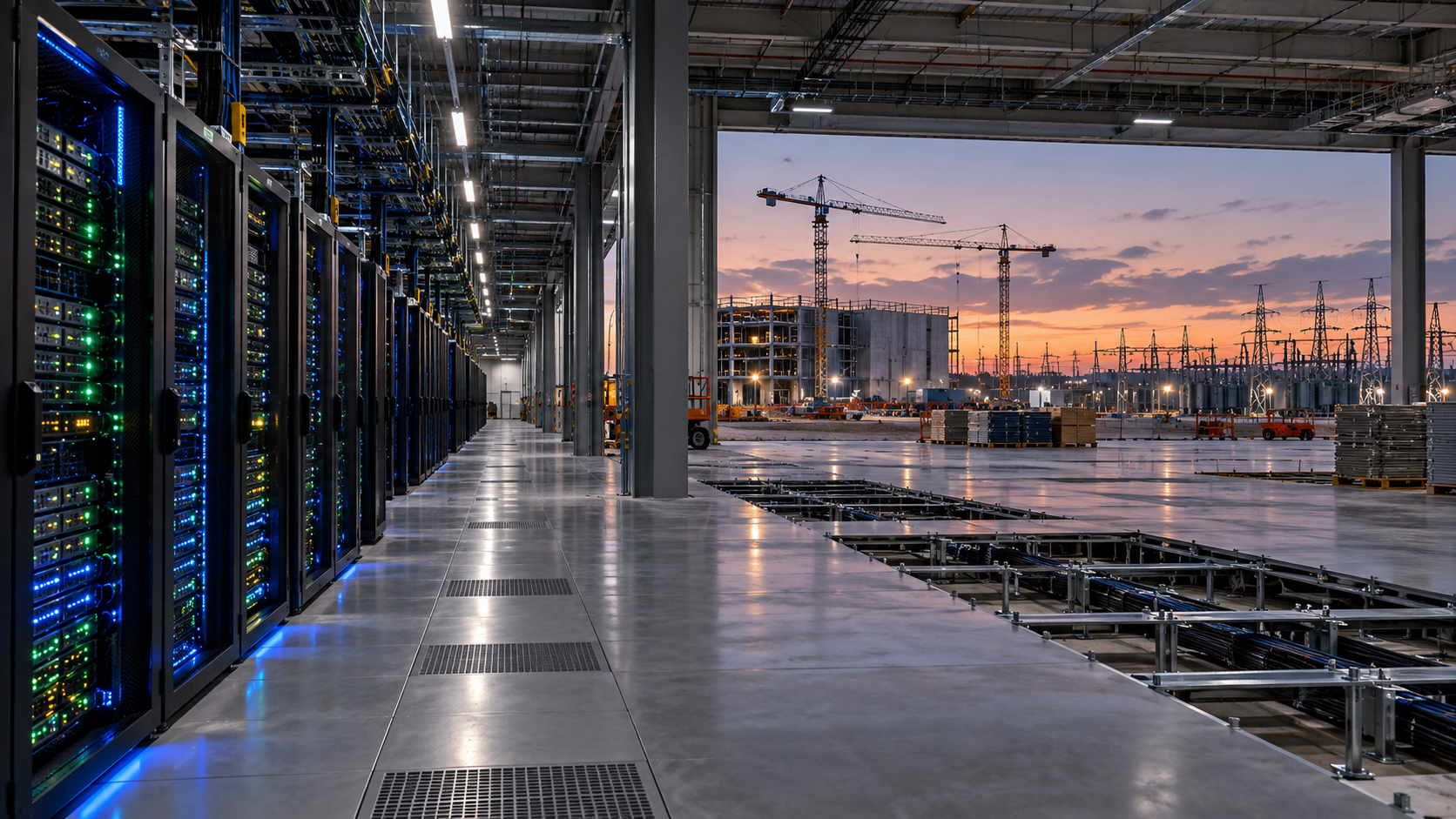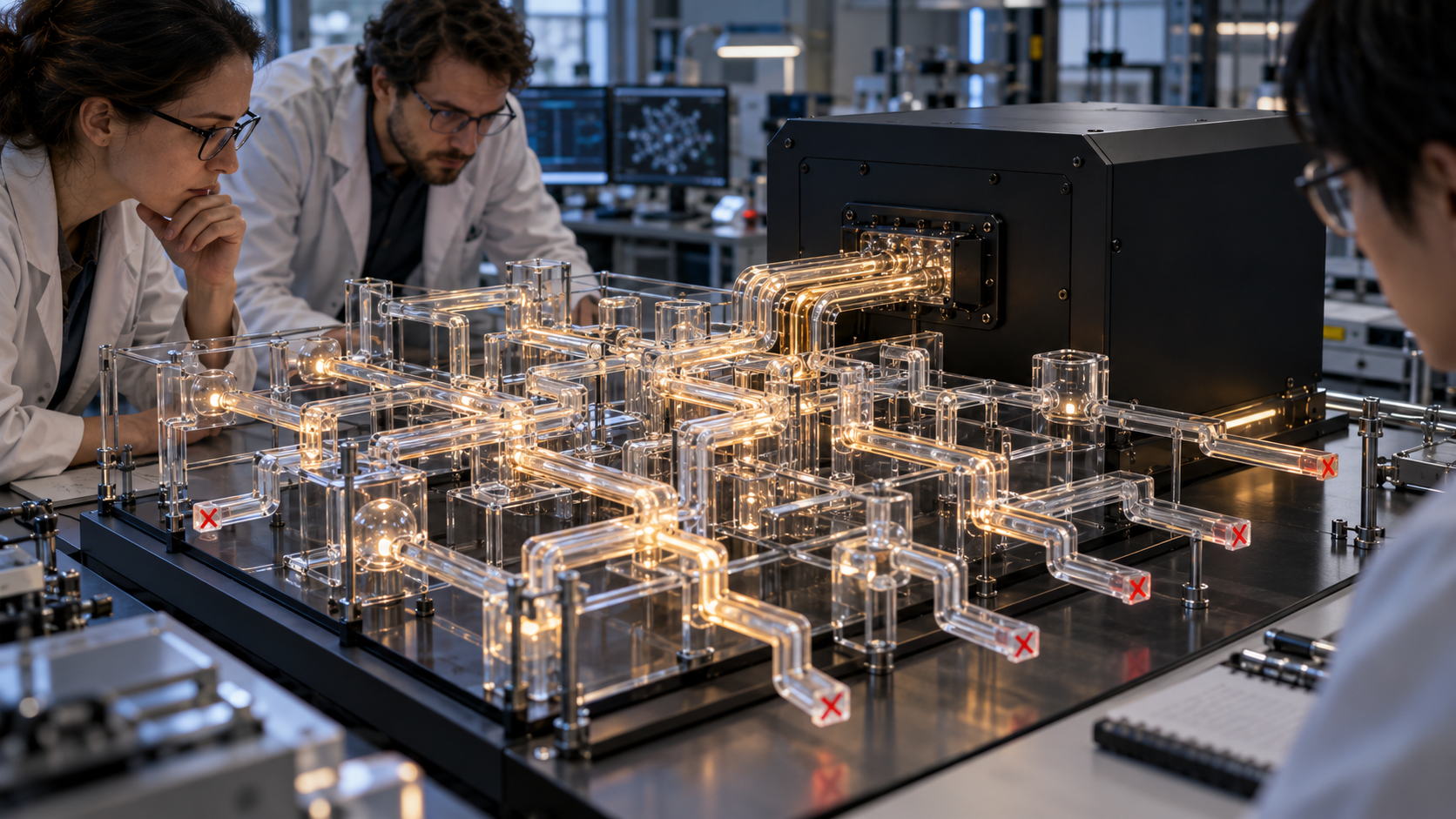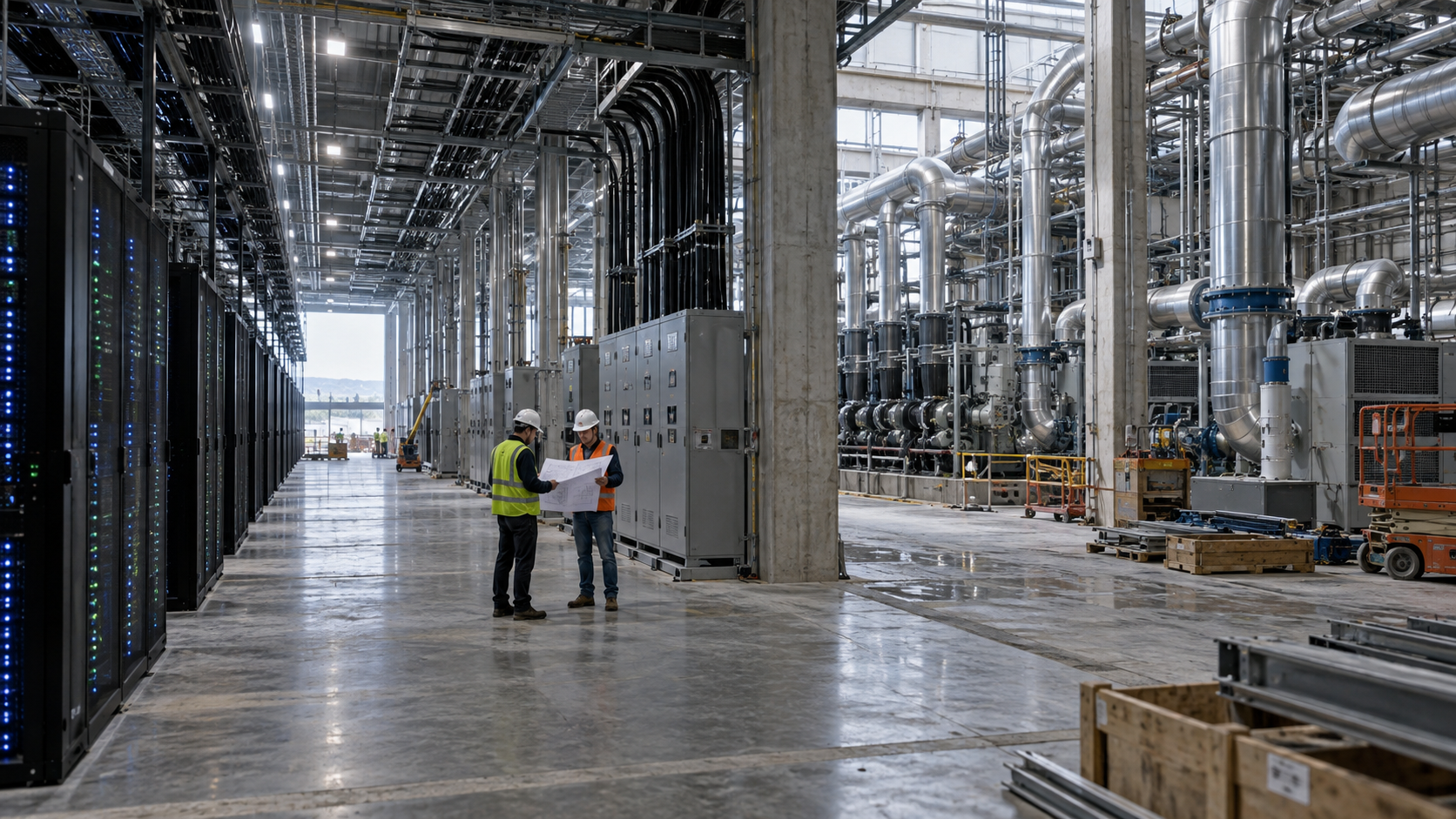
The popular picture of AI infrastructure begins and ends with accelerators. A company secures enough advanced chips, installs them in racks, and obtains intelligence on demand. That picture is already obsolete. A useful AI data center is not a warehouse filled with scarce processors; it is an agreement among electrical grids, cooling systems, construction crews, network operators, regulators, and capital providers.
The hardest asset to acquire may soon be neither a model nor a chip. It may be the right to build a functioning industrial facility in a specific place, on a credible schedule, with enough power to operate it.
The International Energy Agency’s work on energy and AI makes the physical dependency plain: there is no data-center computation without electricity, and demand is geographically concentrated. That local concentration is the key business fact. Global generation capacity can sound adequate while a particular project remains blocked by a substation, transmission queue, water constraint, or years-long permitting process.
Compute is becoming a property development problem
Software businesses are accustomed to assets that can be replicated quickly. Infrastructure does not behave that way. A suitable site must connect to power and fiber, tolerate heavy equipment, satisfy environmental and zoning requirements, and support cooling under local climate conditions. Transformers, switchgear, generators, and construction labor each have their own supply chains. The finished facility must then remain economically useful across several generations of hardware.
This creates a mismatch between AI’s product cycle and its construction cycle. Models, serving techniques, and chip designs can change within months. Grid interconnections and major facilities are planned over years. The investor is effectively making a long-duration bet on a technical workload whose shape is still moving.
That uncertainty does not make construction irrational. It makes flexibility valuable. Facilities designed for one precise rack density or cooling assumption can become stranded even while demand for computation rises. The winning infrastructure may not be the site optimized for today’s flagship cluster, but the one able to absorb changing power densities, cooling methods, and mixes of training and inference.
Utilization is the number behind the spectacle
A giant cluster attracts attention when it is announced. Its economics are determined afterward, hour by hour. Expensive equipment that waits for data, networking, power, or a scheduled training job is not strategic capacity; it is depreciating inventory. The relevant question is not how many accelerators an organization controls, but how much valuable work the whole system produces over its useful life.
This is where software engineering returns to the center of the infrastructure story. Better schedulers, compilers, batching, caching, quantization, and workload routing can increase the output of a constrained physical estate. Model architecture choices can trade memory, communication, latency, and quality in different ways. Research on efficiency is therefore not merely a way to reduce a cloud bill. It is a substitute for some portion of capital expenditure.
Specialist analysis from publications such as SemiAnalysis has helped make the surrounding systems visible: networking, memory, packaging, and power delivery determine how useful nominal compute becomes. Boards evaluating AI investment should adopt the same systems view. Buying the headline component does not guarantee an operational machine.
The balance sheet will shape the model roadmap
Infrastructure commitments also influence research. Once a company has financed a particular fleet, it has an incentive to design models and products that keep that fleet busy. Hardware availability affects architecture experiments; power contracts affect where inference runs; financing terms affect the appetite for uncertain training runs. The supposedly separate decisions of model design and capital allocation begin to converge.
This favors organizations that can coordinate across layers. Hyperscalers have capital and existing energy relationships. Model laboratories have concentrated demand and technical insight. Utilities and infrastructure developers understand projects that software firms often underestimate. None has the entire stack alone, so partnerships will matter—but so will the allocation of risk inside those partnerships.
A power agreement is valuable only if the model business can monetize the resulting capacity. A model advantage is valuable only if deployment economics remain tolerable. A data-center lease is valuable only if the facility arrives before its design assumptions age out. Contract details about delivery dates, curtailment, upgrades, and unused capacity may influence AI margins as much as improvements in benchmark performance.
Durable advantage will look unglamorous
The strategic assets of the next phase are likely to be boring from a distance: interconnection positions, substations, cooling expertise, construction pipelines, procurement relationships, and operating software that raises utilization. They will not produce impressive demonstrations. They will determine who can reliably turn a model into a service at scale.
This also gives smaller AI companies a clearer choice. Trying to imitate the infrastructure footprint of the largest firms is usually a financing strategy disguised as a product strategy. A smaller company should instead know precisely where it can rent commodity capacity, where it needs reserved capacity, and where efficiency or specialization can replace scale.
AI remains a software story, but it is no longer only a software story. The scarce resource is becoming coordinated permission: permission from the grid, the locality, the balance sheet, and the supply chain to convert a plan into operating capacity. Companies that treat those constraints as somebody else’s facilities problem will discover that their model roadmap was an infrastructure roadmap all along.
Advertisement