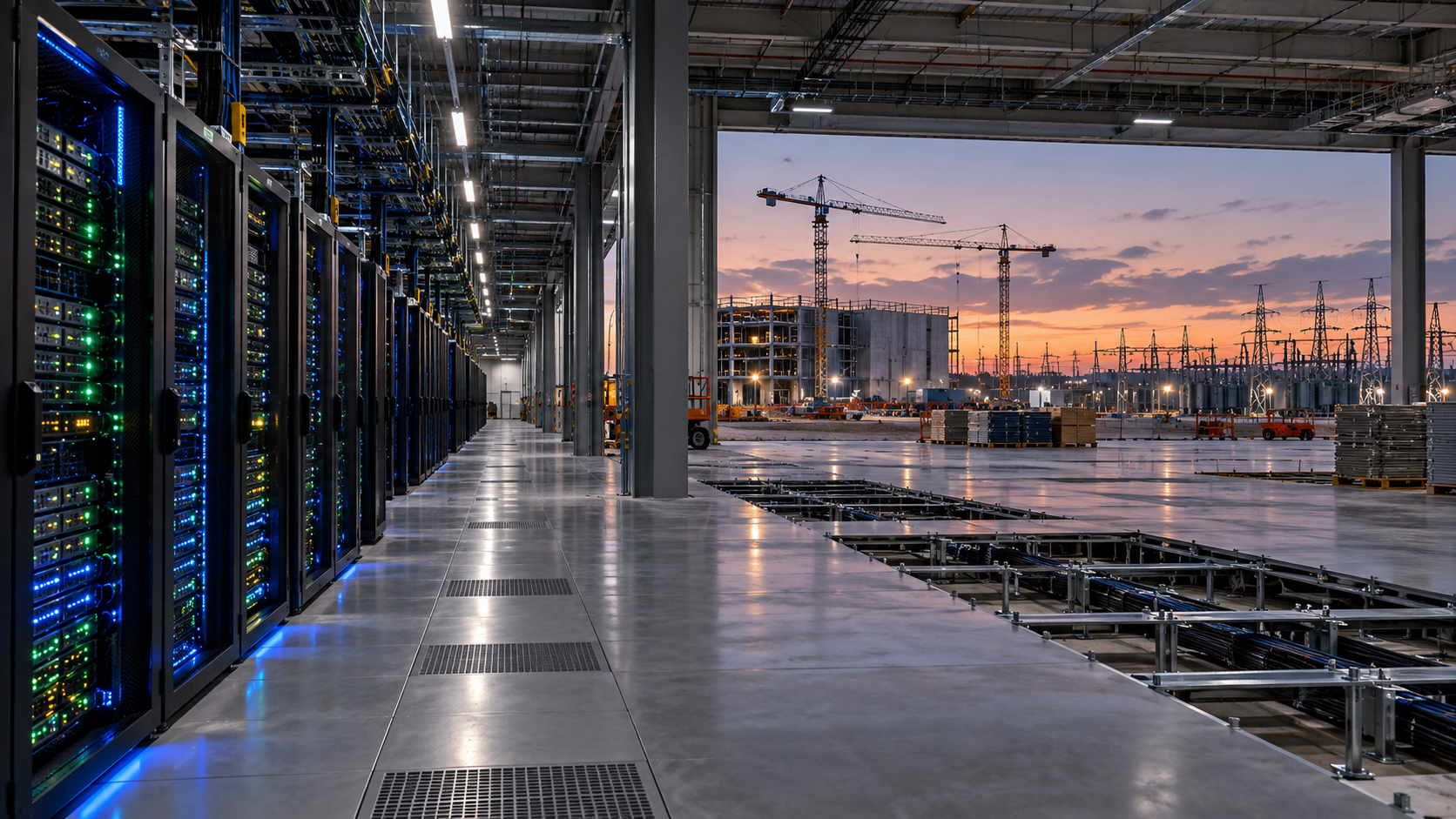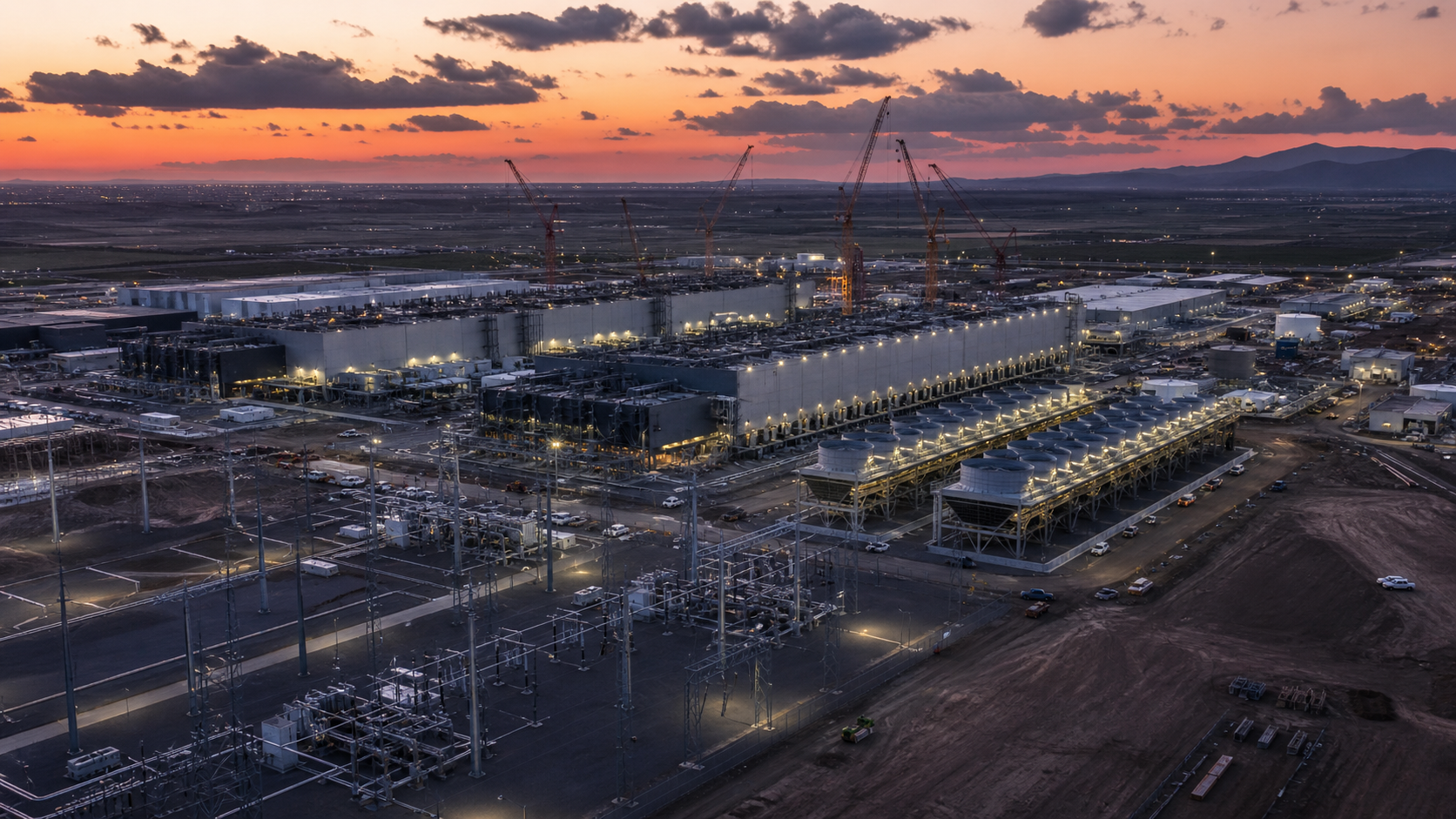
For two years, the AI industry has argued in public as if the decisive competition were happening at the level of prompts, product polish, and benchmark deltas. That story was always incomplete. It is now becoming obviously false. The next durable advantage in AI is not a better system prompt or a more elegant chat surface. It is the ability to line up electricity, data center capacity, cooling, interconnects, and balance sheet tolerance at a scale that most software companies were never built to manage.
This is an awkward shift for the technology sector because it forces software people to think like industrial planners. Open the OpenAI newsroom, the Microsoft AI news feed, or Google's AI coverage, and the pattern is clear even without obsessing over any single announcement. AI is no longer just a model race. It is an infrastructure race wrapped in a product race wrapped in a capital markets story. The firms shaping the market are discussing chips, campuses, sovereign capacity, enterprise platforms, and ecosystem control in the same breath because those subjects are now inseparable.
XioX's view is that this changes how we should think about moats. In classical software, scale often made products cheaper to distribute. In AI, scale can make products harder to supply. If demand outruns compute, the company with the stronger infrastructure position does not merely improve margin. It can determine who gets low latency, who gets reserved capacity, who can afford experimentation, and which new features are economically realistic. That is a deeper advantage than brand voice.
Infrastructure Is Strategy Now
There is a tendency to treat all of this as temporary growing pain, as though the market will soon settle into commodity abundance and the old software assumptions will return. That may happen at the margin for some workloads. It is much less likely to happen at the frontier. Advanced AI systems are hungry not only for training compute but for dependable inference at scale, which means the constraint shifts from a single research event to an ongoing operational posture. Once the market cares about always-on assistants, agents, coding systems, and multimodal tools inside business processes, access to compute becomes part of service quality.
That is why power matters so much. AI demand does not arrive as an abstract cloud. It lands on substations, water planning, utility negotiations, permitting timelines, and construction schedules. The companies that can make those pieces cohere are not simply buying servers. They are building a new kind of supply chain for cognition. This is one reason the AI story increasingly sounds like a mix of telecom, real estate, and heavy industry. That is not a detour from software. It is where software ends up when the software itself becomes capital-intensive infrastructure.
The strategic consequence is that partnerships matter more than ideology. It no longer makes much sense to divide the market into pure model companies, pure cloud companies, and pure application companies. Those boundaries blur under pressure. Labs need distributors, hyperscalers need differentiated models, enterprises need governance and uptime, and governments want domestic capacity and strategic leverage. The old fantasy of a brilliant standalone AI company outrunning structural dependency is fading. The firms that matter most are the ones that can orchestrate dependency instead of pretending to transcend it.
This has another effect that the market still underestimates: it raises the cost of being wrong. If a company overbuilds around a weak model strategy, the waste is enormous. If it underbuilds around a strong one, it loses the moment anyway. That tension will produce more caution in some corners and more concentration in others. It will also reward operators who can translate model uncertainty into portfolio decisions about where to invest and how quickly to commit. In that sense, AI competition is starting to look less like consumer internet competition and more like energy planning under technological volatility.
What Software Buyers Should Learn From This
For enterprise buyers and product builders, the implication is straightforward: vendor evaluation needs to move beyond feature checklists. Capacity resilience, pricing stability, deployment geography, and dependency concentration are now core product considerations. If your business depends on AI for support, code generation, analytics, search, or internal operations, you are no longer only choosing an API. You are choosing a supply posture. That does not mean every customer should become an infrastructure analyst. It does mean the procurement conversation has to get more adult.
There is also a lesson here for smaller AI startups. Many will not win by training frontier models, and they do not need to. But they do need to understand that their own fate is shaped by the infrastructure economics of the platforms beneath them. The best application companies will not just build clever workflows. They will design products that are resilient to shifting model cost curves, intermittent capacity pressure, and the reality that the upstream market is consolidating around a few actors with enormous fixed-cost obligations.
The industry likes to tell a romantic story about intelligence escaping the constraints of the physical world. That story was always nonsense. Intelligence at scale has wires, land, debt, and heat. The companies that admit this early will build better strategy than the ones still arguing over interface metaphors as if infrastructure were somebody else's problem. In the next phase of AI, the prompt still matters. But the harder moat may be the boring, brutal ability to keep the lights on for a system the market suddenly cannot live without.
Advertisement